About Larix decidua Mill.
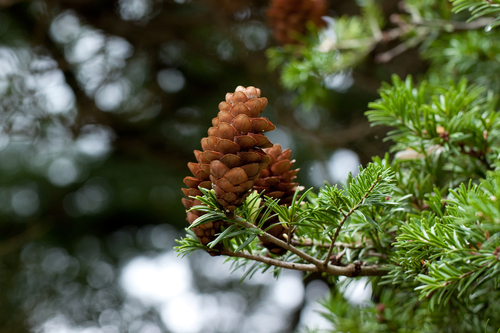
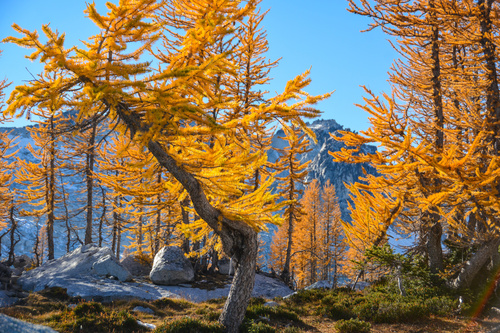
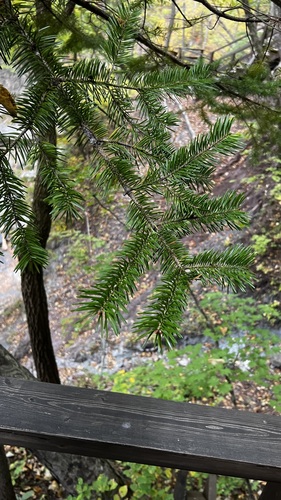
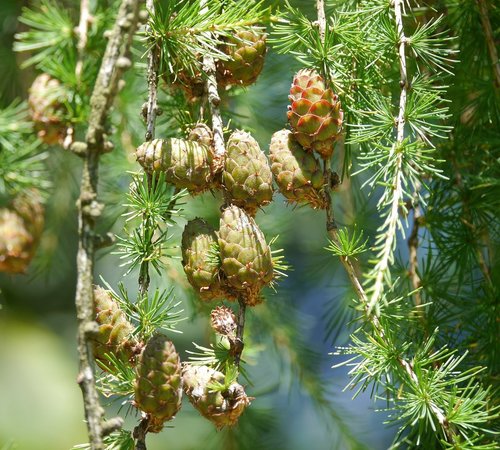
Larix decidua Mill. is a medium to large deciduous coniferous tree. It typically reaches 25 to 45 metres (82 to 148 ft) in height, with a trunk up to 1.5 metres (5 ft) in diameter; exceptional individuals can reach 53.8 metres (176 ft 6 in) in height and 11.20 m in trunk girth, equal to a 3.56 m diameter. The species has a conical crown when young, which becomes broad and often irregular as the tree ages. Main branches grow level to upswept, while side branches are often pendulous. Shoots are dimorphic, with growth split into two forms: long shoots are typically 10 to 50 cm (4 to 20 in) long and bear multiple buds, while short shoots are only 1 to 2 mm long and hold just a single bud. Its leaves are needle-like, light green, and 2 to 4 centimetres (3⁄4 to 1+5⁄8 in) long. They turn bright yellow before falling in autumn, leaving pale yellow-buff shoots bare until the following spring. Cones are erect and ovoid-conical, 2 to 6 centimetres (3⁄4 to 2+3⁄8 in) long, with 10 to 90 erect or slightly incurved, non-reflexed seed scales. They are bright pinkish-red when pollination occurs, then turn green with variable red to purple flushing when immature. They mature to brown and open to release seeds 4 to 6 months after pollination. Old cones commonly remain on the tree for many years, fading to a dull grey-black colour. This species is very cold tolerant, able to survive winter temperatures down to at least −50 °C (−58 °F), and is one of the tree line species in the Alps, reaching up to 2,400 m (7,900 ft) in altitude, though it is most abundant between 1,000 and 2,000 m (3,300 and 6,600 ft). It only grows on well-drained soils, avoids waterlogged ground, and is not shade tolerant. It is closely related to the Siberian larch Larix sibirica and similar in morphology; the two can best be distinguished by the dense pubescence on the cone scales of L. sibirica, while L. decidua has glabrous or only thinly pubescent cone scales. In its ecology, Larix decidua seeds are an important food source for some birds, notably siskins, redpolls, and citril finches, while capercaillie eat the buds and immature cones. Larch needles, including those of L. decidua and L. sibirica, are the only known food source for caterpillars of the case-bearer moth Coleophora sibiricella; the species' cone scales are used as food by caterpillars of the tortrix moth Cydia illutana. Larix decidua is susceptible to larch canker caused by Lachnellula willkommii. Larix decidua is widely cultivated as an ornamental tree for planting in gardens and parks. It was first cultivated in Britain in or shortly before 1629. John Evelyn encouraged wider planting and use of the species. Three successive Dukes of Atholl planted it widely, and the fourth Duke wrote "Observations on Larch" in 1807 to further encourage its cultivation, which he practiced on a large scale. One larch planted by the second Duke of Atholl at Dunkeld in 1737 is still standing, along with two slightly older specimens planted in 1725 at Kailzie, near Peebles in southern Scotland. European larch is now widely naturalised in northern Europe outside its native range, including Britain, Scandinavia, and Germany north of its original distribution. It is also widely cultivated in southern Canada and the northeastern United States, and is naturalised in Maine, Michigan, New York, Pennsylvania, Connecticut, New Hampshire, Vermont, and Rhode Island. In the northern Appalachian Mountains, it is often used for the reforestation of surface mines. European larch can grow on drier soils and tolerate warmer climates than tamarack (Larix laricina) or Siberian larch (Larix sibirica), making it better suited to non-boreal climates. Its wood is tough and durable, and also flexible when cut into thin strips. It is particularly valued for yacht building; wood used for this purpose, known as 'boatskin larch', must be knot-free, and can only be obtained from old trees that were pruned when young to remove side branches. Small larch poles are widely used for rustic fencing. Because of its fast juvenile growth and pioneer character, larch has many applications in forestry and agroforestry. It is used as a 'preparatory species' to afforest open land, abandoned farmland or disturbed land, and as a 'nurse species' before more demanding species are introduced.