About Laguncularia racemosa (L.) C.F.Gaertn.
Taxonomic Classification
Laguncularia is a plant genus belonging to the family Combretaceae, with Laguncularia racemosa (common name white mangrove) as its only species.
Native Distribution
This species is native to multiple coastal regions: the coasts of western Africa from Senegal to Cameroon, the Atlantic coast of the Americas ranging from Bermuda and Florida through the Bahamas, Mexico, and the Caribbean, and extending south to Brazil; as well as the Pacific coast of the Americas from Mexico to northwestern Peru, including the Galápagos Islands.
Mature Size
White mangrove is a mangrove tree that reaches a height of 12–18 m (39–59 ft).
Bark Characteristics
Its bark is gray-brown or reddish, with a rough, fissured texture.
Root Structure
Depending on environmental conditions, it may have pneumatophores, prop roots, or both.
Leaf Arrangement and Shape
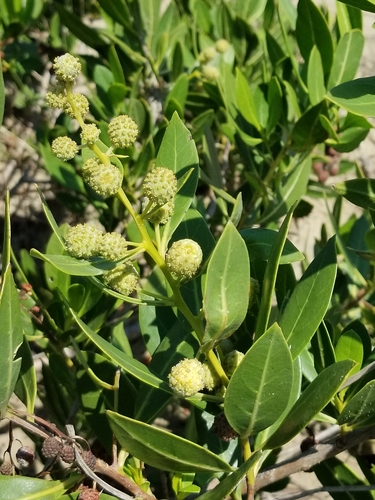
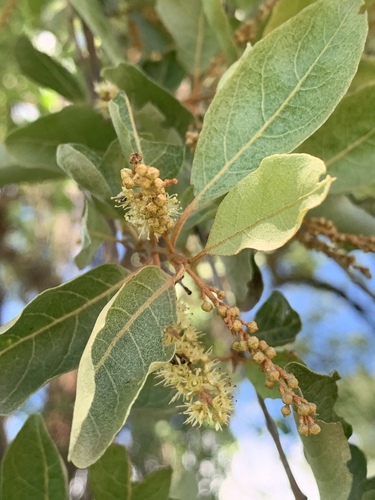
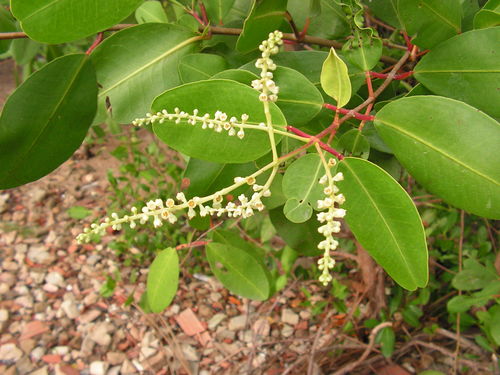
Its leaves are arranged oppositely, and have an elliptical shape.
Leaf Dimensions and Appearance
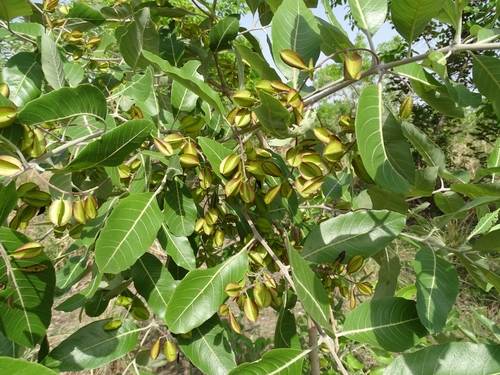
They measure 12–18 cm (4.7–7.1 in) long and 2.5–5.0 cm (0.98–1.97 in) wide, are rounded at both ends, have entire margins, are smooth and leathery, slightly fleshy, lack visible veins, and are yellow-green in color.
Petiole Features
The leaf petiole is stout, reddish, 10–13 mm (0.39–0.51 in) long, and bears two small sugar-exuding glands near the leaf blade.
Flower Characteristics
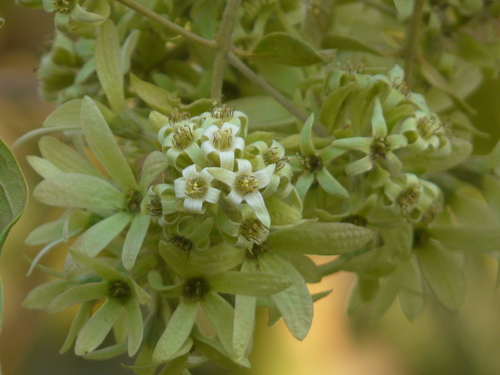
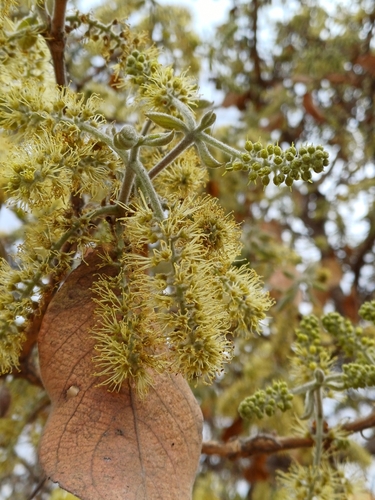
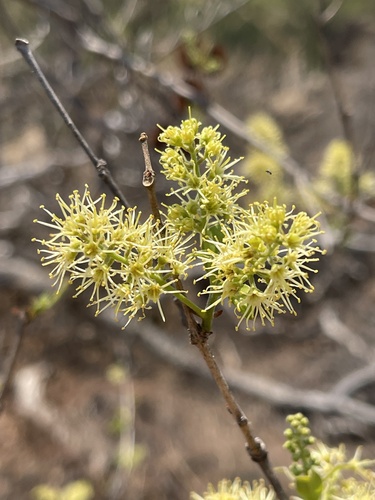
The flowers are white, bell-shaped, mostly bisexual, and around 5 mm (0.20 in) long.
Fruit Traits
The fruit is a reddish-brown drupe that measures 12–20 mm (0.47–0.79 in) long and marked with longitudinal ridges.
Seed Traits
The single seed contained in the fruit is sometimes viviparous.
Habitat
This species grows in the coastal areas of bays, lagoons, and tidal creeks, and typically occurs inland of other mangrove species, well above the high tide line.