About Labrus bergylta Ascanius, 1767
Common Name and General Body Form
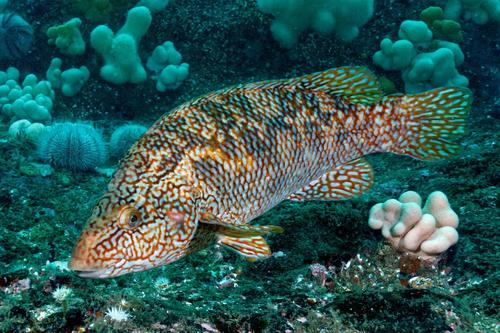
Labrus bergylta, commonly known as the ballan wrasse, is a large, heavy-bodied wrasse with a relatively deep body and large head. It has a moderately small mouth surrounded by thick, fleshy, noticeably wrinkled lips.
Jaw Dentition
The jaws hold a single row of robust teeth: these teeth are sharp and pointed in young fish, but become blunter and more worn as the fish ages.
Dorsal Fin Structure
Its long dorsal fin has 18 to 21 spines in the front section and 9 to 13 branched rays in the rear section.
Anal Fin Structure
The anal fin is distinctly shorter and has three spines.
Scale Characteristics
It has large scales, with 41 to 47 scales along its lateral line.
Juvenile Colouration
Juvenile ballan wrasses have colouration that matches their habitat, ranging from light green to dark green, and some individuals are bright emerald green.
Adult Colour Forms
Adult ballan wrasses have highly variable colouration, with two main colour forms that occur together in the same range. One form is plain green or brown, while the other is reddish with white spots.
Colour Variation Cause
This colour variation is not caused by sexual dimorphism, as both males and females can display either colour form.
Size Difference by Colour Form
Spotted ballan wrasses grow larger than plain-coloured individuals.
Human Perception of Colour Forms
In regions such as Galicia, the two colour forms are sold separately, and local fishermen often treat them as separate species.
Size and Weight
The species can reach a maximum total length of 65.9 cm (25.9 in), though most individuals do not exceed 50 cm (20 in) in standard length, and the heaviest recorded specimen weighed 4.4 kg (9.7 lb).
Reproductive and Swimming Traits
Ballan wrasses are protogynous hermaphrodites, and classic labriform swimmers: they primarily swim using their pectoral fins, use burst and glide swimming to reach higher speeds, and cannot perform sustained swimming well.
Geographical Range
This species is native to the northeastern Atlantic Ocean, ranging from Norway to Morocco, and including the islands of Madeira, the Azores and the Canary Islands.
Mediterranean Occurrence Status
There are records of this species from the Mediterranean Sea, but these are considered questionable and likely represent misidentifications of the brown wrasse Labrus merula.
Depth and Habitat
Ballan wrasses live at depths between 1 and 50 m (3.3 to 164.0 ft), in habitats with rocks, seaweed, and reefs.
Sex Change Pattern
All ballan wrasses are female for the first four to 14 years of life, after which only a small number change sex to become males. Almost all large individuals of this species are male.
Feeding Adaptations
The ballan wrasse’s thick lips and sharp front teeth are an adaptation for prying shellfish loose from rock surfaces. These are complemented by powerful pharyngeal teeth located further back in the throat, which can crush shells to access the soft flesh inside.
Diet
This species also feeds on crustaceans, including hard-shelled crabs and small lobsters.
Feeding Habitat
It will move into shallower water to hunt for shellfish that cling to underwater cliff faces and inshore rocks. It also lives in areas with thick coverage of kelp and other seaweeds.
Reproductive Behavior
Males build an algae nest in a rock crevice, where one or more females deposit eggs. The male defends the nest until the eggs hatch into pelagic larvae after one to two weeks.
Lifespan and Digestive Trait
The maximum recorded lifespan of this species is 34 years, and ballan wrasses do not have stomachs.