About Lablab purpureus (L.) Sweet
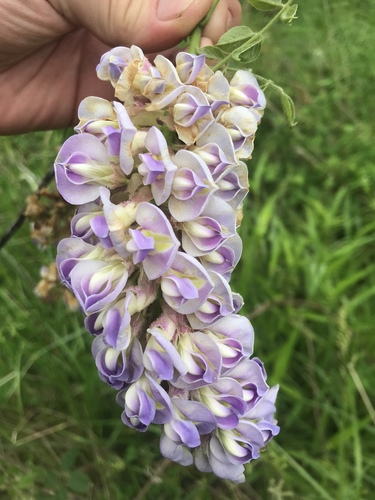
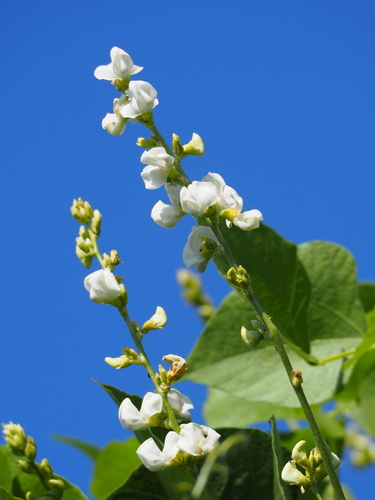
Lablab purpureus (L.) Sweet, commonly called hyacinth bean, is a variable species due to extensive breeding for cultivation. In general, cultivated forms are annual or short-lived perennial vines, while wild types are perennial. Its thick stems can grow up to 6 meters (20 ft) long. Leaves are compound, formed of three pointed leaflets that each reach up to 15 centimeters (6 in) in length, and leaflets may have fine hairs on their undersides. Flowers are arranged in multi-flowered racemes; cultivars may produce white, purplish, or blue blooms. The fruit is a legume pod that varies widely in shape, size, and color, usually measuring several centimeters long and ranging in color from bright purple to pale green. Each pod holds up to four seeds, which vary in color by cultivar: they may be white, brown, red, or black, and sometimes have a white hilum. Wild plants always produce mottled seeds, and individual seeds are roughly one centimeter long.
Cultivation practices vary because this species has high phenotypic variability, including differences in relative maturity, yield, insect susceptibility, and drought resistance, so practices are adjusted to the specific plant accession and local environmental conditions. When first planted in a field, it is beneficial to inoculate seeds with specialized rhizobium bacteria. Seeds are either broadcast and then covered, or sown to a depth of 5 cm via the drillseed technique. The seedbed must be kept free of weeds during early growth, as young plants are easily outcompeted by weeds. For fodder harvest, harvesting at the transition between vegetative and reproductive growth stages is generally accepted as the best compromise between yield and quality. After this stage, plants develop higher fiber and lignin content and lower protein content, which reduces digestibility and acceptability for livestock. When storing lablab as hay, the main challenge is dry matter loss from the leaves; farmers recommend grinding the hay and storing it in bags, which also prevents damage from direct sunlight or rain.
Hyacinth bean is an ancient domesticated pulse and multi-purpose crop, with cultivation documented in India as early as 2500 BC. Due to widespread seed availability of the forage cultivar Rongai, it is often grown as livestock forage and as an ornamental plant. It is also recorded as both a medicinal plant and a poisonous plant. Its fruit and beans are edible only if boiled thoroughly with multiple changes of water; raw or underprepared parts are toxic because they contain cyanogenic glycosides, which convert to hydrogen cyanide when consumed. Poisoning symptoms include weakness, vomiting, shortness of breath, twitching, stupor, and convulsions. Varieties of this species have a wide range of cyanogenic potential. The leaves can be eaten raw or cooked like spinach, flowers can be eaten raw or steamed, the root can be boiled or baked for food, and seeds can be processed to make tofu and tempeh.
In South Asian cuisine, the plant has many regional uses. In Bangladesh and West Bengal, green pods and beans called śim are cooked as a vegetable or added to fish curries. In Gujarat it is called surti papdi or valor, and in Maharashtra it is called val papdi; in both Indian states, it is commonly used to make spiced sautéed vegetable dishes called sabjis. In Kerala, it is known as amarakka, avara, or amara payar; beans and pods are used in curries, and pods are also combined with spices to make a stir-fried dish called thoran. In Tamil Nadu, it is called avarai or avaraikkaay; the whole bean is used in dry curries and gravies such as sambar, while the seed alone is used in many recipes where it is called mochai. In Maharashtra, dry preparations with green masala are often made from green lablab beans of varieties like ghevda, Shravan ghevda, bajirao ghevda, ghevda, walwar, and pavta sheng, most often during Shravan month fasting festivals at the end of monsoon season. In Karnataka, hyacinth bean is used to make curry called avarekalu saaru, salad called avarekaalu usli, added to upma as avrekaalu uppittu, and used as a flavoring for Akki rotti. Sometimes the outer seed peel is removed and the soft inner part is used for multiple dishes; this form is called hitakubele avarekalu (meaning pressed hyacinth bean), and a curry called hitikida avarekaalu saaru is made from the deskinned seeds. In Telangana and Andhra Pradesh, bean pods are cut into small pieces and cooked as a spicy curry during the Pongal festival season. When seeds are tender and soaked overnight, the outer peel may be removed to use the soft inner part in a range of dishes; this form is called pitakapappu hanupa/anapa (meaning pressed hyacinth bean), and a curry called pitikina anapaginjala chaaru or pitaka pappu is made from the deskinned seeds and served with bajra bread.
In Southeast and East Asian cuisine, hyacinth bean also has traditional uses. In Myanmar, lablab beans are used to make a braised Burmese curry called hnat (ပဲကြီးနှပ်), and they are also crisp-fried and served in Burmese pickled tea leaf salad. In Huế, Vietnam, hyacinth beans are the main ingredient of the sweet soup chè đậu ván. In China, the seeds are called Bai Bian Dou; they are usually dried and baked before use in traditional Chinese herbal remedies to strengthen the spleen, reduce heat and dampness, and promote appetite.
In East African food tradition, in Kenya the bean, known locally as njahe or njahi, is popular among several communities, especially the Kikuyu. Historically, seasonal cycles were marked relative to its growing season, called the Season of Njahe (Kīmera kīa njahī). It is traditionally thought to encourage lactation and has historically been the main dish for breastfeeding mothers. The beans are boiled and mashed with ripe and/or semi-ripe bananas to make a sweet-tasting dish. Today, production of this bean is declining in eastern Africa, partially because farmers in colonial Kenya were forced to abandon this local bean to grow common beans (Phaseolus vulgaris) for export.
For medicinal use, Taiwanese researchers have found that a carbohydrate-binding legume lectin protein from lablab beans effectively blocks infection by influenza viruses and SARS-CoV-2. Researchers from Finland and the United States found that extracts from lablab bean seed manufactured into chewing gum have broad-spectrum antiviral properties, likely due to the binding action of Flt3 Receptor Interacting Lectin (FRIL) on viruses; the observed antiviral effect was similar to that of purified FRIL.