About Kinosternon oaxacae Berry & Iverson, 1980
Species Identification
This species, the Oaxaca mud turtle (Kinosternon oaxacae), exhibits distinct size differences between sexes.
Adult Size
Males grow to a carapace length of roughly 160 mm (6 in), while females are slightly smaller.
Male Sexual Maturity
Males reach sexual maturity at a shell length of approximately 113 to 125 mm, when they are between 7 and 10 years old.
Female Sexual Maturity
Females reach maturity at a shell length of around 115 mm, when they are between 8 and 9 years old.
Carapace Structure
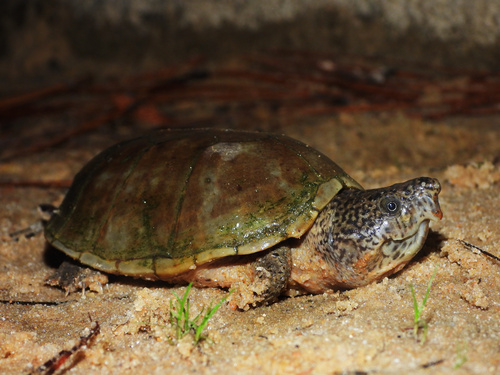
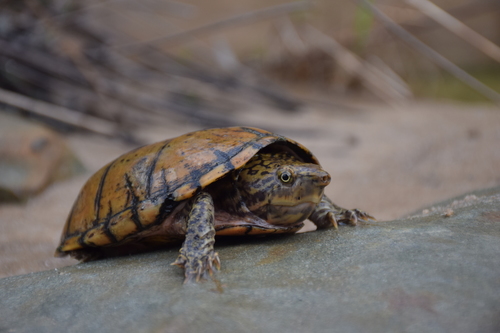
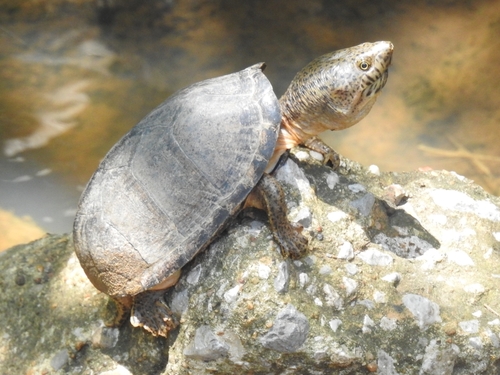
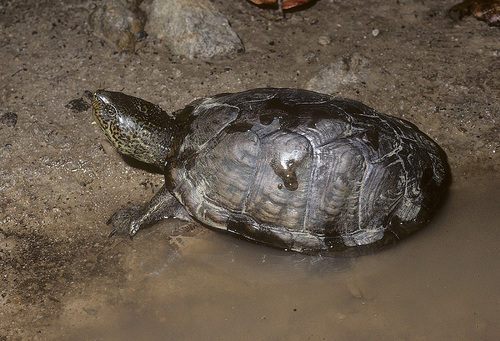
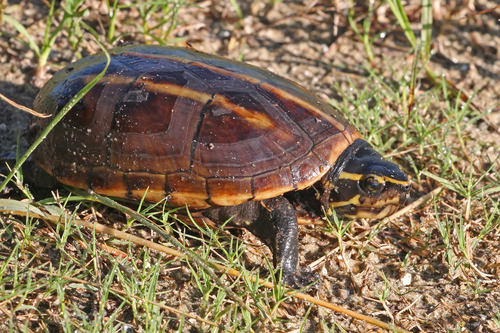
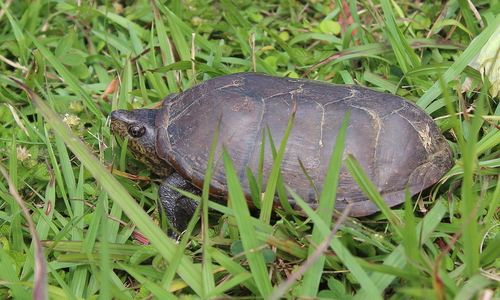
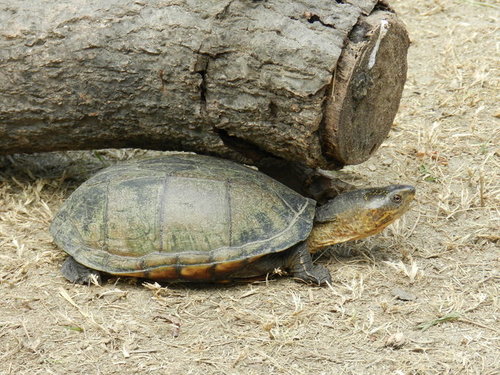
The carapace is slightly depressed, with three distinctive longitudinal keels; its width is about 60% of its length, and 35% of its height.
Carapace Coloration
Carapace color ranges from dark brown to blackish, or a mottled combination of the two.
Shell Seam Color
In lighter-colored individuals, the shell seams are darker.
Plastron Size
The plastron is relatively narrow, measuring about two-thirds the width of the carapace.
Plastron Shape
It is concave in males, and nearly flat in females.
Plastron Coloration
Plastron color is yellowish or pale brown, with darker seams.
Rostral Shield Shape
This turtle has a V-shaped or bell-shaped rostral shield.
Head Coloration
The head is dark brown or black, mottled with cream; it may sometimes be reticulated, but it is never striped.
Head Underside and Barbels
The underside of the head and throat are cream, and three or four pairs of barbel are present on the chin and throat.
Limb Coloration
The upper surfaces of the limbs are grey or brown, and the lower surfaces are cream.
Tail Coloration
The tail is uniformly greyish brown.
Endemic Range
This mud turtle is endemic to Mexico.
Distribution Within Mexico
It occurs only in the Mexican states of Guerrero and Oaxaca, where it is restricted to the drainage basins of the Rio Colotepec and the Rio Tonameca.
Altitude Range
It inhabits altitudes between roughly 100 and 800 m (300 and 2,600 ft).
Preferred Habitats
Its preferred habitats are marshes, muddy pools, and other still, turbid water bodies.
Occasional Habitats
It occasionally occurs in rivers, and is sometimes found on the coastal plain after being washed downstream by flooding rivers.
Diet Components
The diet of the Oaxaca mud turtle is mostly made up of plant material, but it also eats small animals including tadpoles, shrimps, beetles, and fish.
Feeding Strategy
Unlike other species in the genus Kinosternon, this species is an opportunistic feeder that consumes both plant matter and small animals.
Activity Period
These turtles are most active during the rainy season, which runs from June to October.
Breeding and Hatching Timeline
Breeding likely occurs in July, and eggs hatch after the rains end.
Juvenile Growth Rate
Young turtles grow slowly, taking between 7 and 10 years to reach maturity.