About Kennedia prostrata R.Br.
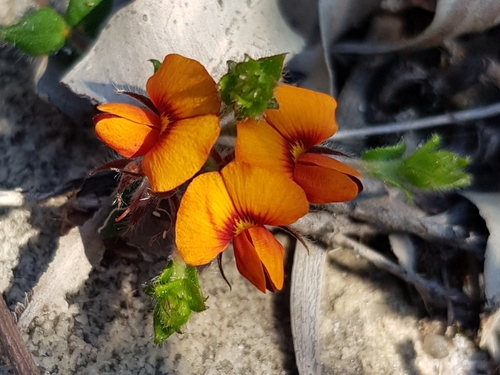
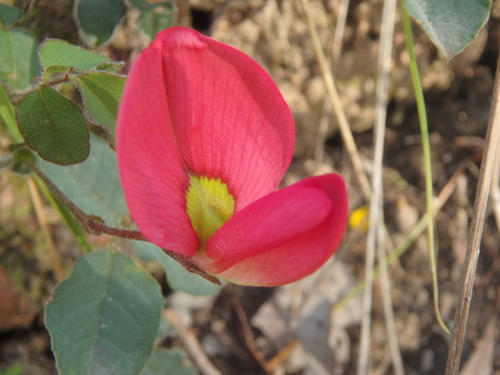
Kennedia prostrata is a prostrate or twining shrub with wiry stems up to 2 metres (6 feet 7 inches) long. Young stems are covered in fine hairs. Its leaves are borne on a petiole 5 to 50 millimetres (0.20 to 1.97 inches) long, and consist of more or less round leaflets that measure 6 to 35 millimetres (0.24 to 1.38 inches) in both length and width, with wavy edges. The terminal leaflet sits on a petiolule 2 to 9 millimetres (0.079 to 0.354 inches) long, while the side leaflets are more or less sessile. A heart-shaped stipule around 5 millimetres (0.20 inches) long is present at the base of the petiole. Flowers are produced singly or in pairs on a peduncle 5 to 30 millimetres (0.20 to 1.18 inches) long, with bracts 2 to 5 millimetres (0.079 to 0.197 inches) long at the base of the peduncle; individual flowers sit on pedicels 5 to 25 millimetres (0.20 to 0.98 inches) long. The five hairy sepals are 6 to 8 millimetres (0.24 to 0.31 inches) long. Petals are usually scarlet, and rarely white. The standard petal is 13 to 23 millimetres (0.51 to 0.91 inches) long, the wing petals are 12 to 18 millimetres (0.47 to 0.71 inches) long, and the keel petal is 12 to 22 millimetres (0.47 to 0.87 inches) long. Flowering takes place from April to November, and the resulting fruit is a flattened cylindrical pod 20 to 50 millimetres (0.79 to 1.97 inches) long. Common name running postman, this species is found in all Australian states and territories except Queensland and the Northern Territory. It grows in a wide range of habitats, most often on coastal sand dunes and rock outcrops. In horticulture, Kennedia prostrata is naturally adapted to sandy or lighter soils and prefers a sunny growing position. It is a widely cultivated species that grows well in temperate to subtropical areas and is hardy in most growing situations.