About Strongylodon macrobotrys A.Gray
Nomenclature
Strongylodon macrobotrys A.Gray, commonly known as jade vine, has thick stems up to 2 cm in diameter, which it uses to climb tall trees to reach sunlight.
Stem Dimensions
The total length of its stems can reach up to 18 m.
Climbing Habit
This vine entwines itself around the trunk and branches of its host tree. Like kudzu, which shares the same plant subfamily, jade vine can completely smother dead, dying, or severely damaged trees.
Foliage Arrangement
It has pale green foliage that spreads over the host tree's canopy, with leaves arranged in an alternate pattern.
Leaf Structure
Each leaf is made up of three oblong leaflets with mucronate tips, and the middle leaflet is the largest.
Native Habitat
This plant grows alongside streams in damp forests or in ravines.
Taxonomic Distinction
While there are multiple other species in the Strongylodon genus, the superficially similar red jade vine belongs to a different genus entirely, and is classified as Mucuna bennettii.
Endemic Range
Jade vine is endemic to the Philippines, where it typically grows in forests.
Conservation Status
Propagation of this species has always been difficult, and it is classified as endangered due to habitat destruction and population decline of its natural pollinators.
Marcotting Propagation
A propagation method using marcotting on mature woody stems has been developed.
Water Requirements
It grows best when planted in the ground near a water source, but does not tolerate being fully inundated.
Temperature Tolerance
Strongylodon macrobotrys is not frost-tolerant, and requires a minimum temperature of 15 °C (59 °F).
Cold Climate Cultivation
In regions with colder climates at higher latitudes, it must be grown in a large glasshouse or conservatory.
Ornamental Value
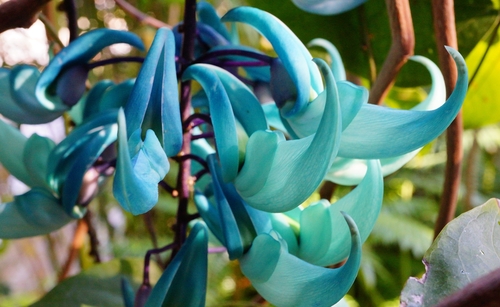
It is highly valued in tropical and subtropical gardens for its showy flowers, which have a highly unusual color found in almost no other plant.
Cultivation Support Structure
It is usually grown over a pergola or other tall support structure to show off its spectacular cascading flower trusses, which are produced abundantly once the vine matures, which takes 2 years or more depending on the pruning routine used.
Bloom Visibility
Unusually, pale-colored blooms on a large jade vine can be hard to see in strong sunlight, and could be overlooked if not for the fallen blooms that collect below the vine.
Fallen Bloom Color Change
Fallen blooms change color as they dry, shifting from mint green to blue-green to purple.
Cultivated Seed Production
Seed pods do not typically form in cultivation, but Kew Gardens has successfully pollinated the flowers and produced seeds by mimicking the actions of the species' natural pollinators.
Cutting Propagation
Jade vine can also be propagated from nodal cuttings.
Edible Flowers
The flowers of jade vine are edible.
Local Culinary Use
On the native island of Luzon, where the plant is called tayabak in Tagalog, local people eat the flowers as vegetables prepared in a similar way to katurai.