About Kelleria dieffenbachii (Hook.) Endl.
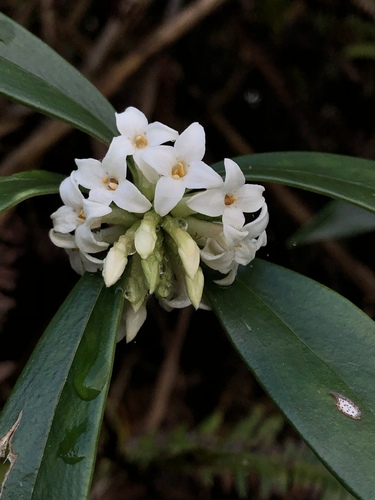
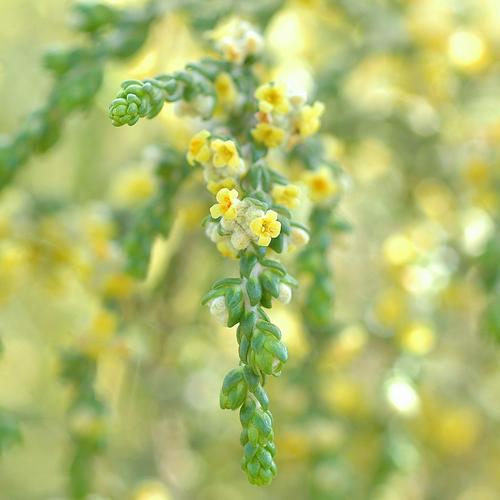
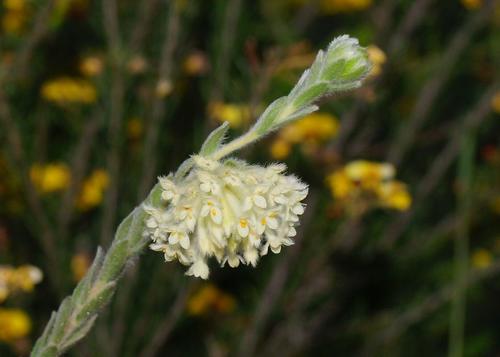
Kelleria dieffenbachii (Hook.) Endl. is a low-lying perennial shrub that forms large patches of woody tufts, with patches reaching up to 25 centimeters in diameter. Its stems and branches grow prostrate, and produce new roots as they spread. Glabrous branchlets grow up to 5 centimeters long. Its leaves taper toward their tip. Each flower head holds 3 to 8 white florets that are 1.5 to 2 millimeters long. Flowers on this species may be unisexual or bisexual, with both flower types occurring on the same individual. Flowering occurs from December through February during the austral summer; in New Zealand, flowering may take place from October through May, while flowers have only been recorded in September and December in New Guinea. This species is often found growing alongside Kelleria villosa, and can be distinguished from K. villosa by its stem: K. dieffenbachii stems are typically glabrous or bear only very few scattered hairs, which are most often concentrated at the leaf base. This species is native to the southern hemisphere. It is indigenous to New Zealand, where it occurs on both of the country’s main islands, Stewart Island / Rakiura, and may also be present on the Chatham Islands and Auckland Islands. It is also found in Australia, including Kosciuszko National Park and Tasmania. In New Guinea, it grows at elevations above 3000 meters, including locations such as Puncak Trikora in the Sudirman Range. K. dieffenbachii grows in alpine feldmark, subalpine areas, and subarctic areas. In the South Island of New Zealand, it prefers drier sites than other Kelleria species. It grows in well-drained gravel areas, and occasionally occurs in Sphagnum peat bogs. The species shows regional morphological variation: plants growing near Taranaki Maunga are fully glabrous; plants from Mt. Hikurangi are more erect and bright green; stem hairs are longer in Marlborough populations than elsewhere; and plants from lower altitudes bear hairs at the leaf tip. Kelleria laxa is sometimes treated as a variant of this species, and sometimes recognized as a separate species. It is possible that achenes of K. dieffenbachii are dispersed by wind, but zoochory via invertebrates may also be the main dispersal method for the indehiscent drupe. Anagotus weevils and other insects are known to graze on K. dieffenbachii at night in the Tararua Range. This species grows in Chionachloa grassland and on forest edges, where it associates with Dracophyllum, Olearia, Cassinia, Dacrydium, and Kelleria villosa. This species can be cultivated, most successfully in rock gardens that replicate its native alpine and subalpine habitat. It can be propagated from seed or by plant division. Cold stratification can speed up germination, which normally takes around four weeks without treatment.