About Kassina senegalensis (Duméril & Bibron, 1841)
Common Name and General Build
Kassina senegalensis, commonly known as the Senegal running frog, is a relatively small and stocky frog species.
Mouth and Oral Structures
The vomer teeth in its upper mouth are arranged in two small groups, and its tongue is heart-shaped. Its Eustachian tubes are quite small, and its eardrums are indistinct due to the layer of skin covering them.
Finger Structure
Its four unwebbed fingers are, from shortest to longest: first, second, fourth, and third. Its toes are also unwebbed.
Head and Eye Features
The eyes are large and somewhat protruding, and the head is shaped like an equilateral triangle that is rounded at the tip. The entire body has a smooth texture.
Body Coloration
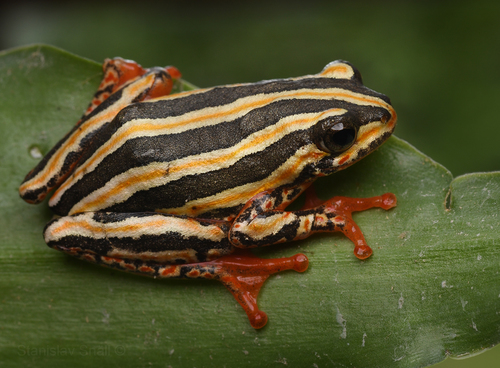
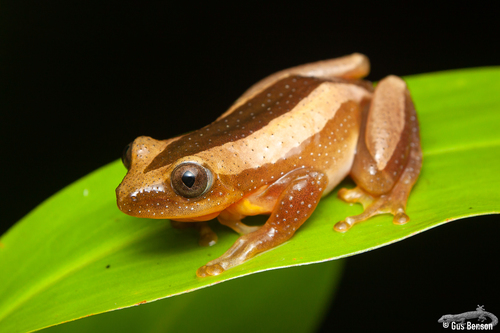
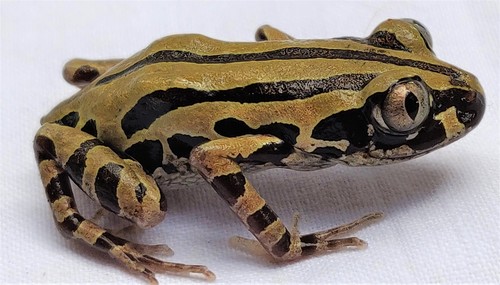
Its base color is greyish black, marked with brown longitudinal bands and brown spots across various parts of the body, including the ears and eyes.
Adult Body Size
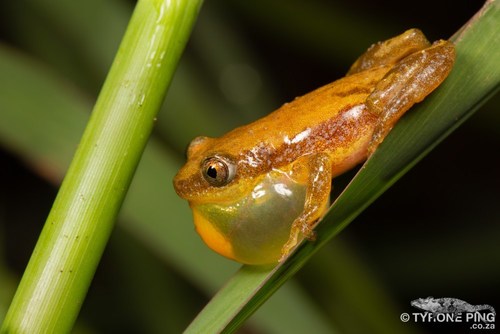
Adult Senegal running frogs range from 35 to 40 millimetres (1.4 to 1.6 in) in length. Males are slightly smaller than females, and they have chocolate-colored vocal sacs that can expand to nearly twice their normal size when calling.
Egg Dimensions
Kassina senegalensis eggs measure around 3 millimetres (0.12 in) in diameter when including the jellylike membrane that covers them.
Tadpole Identification Traits
Identifying Kassina senegalensis tadpoles can be difficult, as they have high individual variation, a trait shared with other species in the genus Kassina. Tadpoles grow up to 75 millimetres (3.0 in) long, and have wide fins and humped backs.
Geographical Range
Kassina senegalensis is found across a large area of Africa, ranging from Senegal in the west to Ethiopia and Somalia in the east, and extending south as far as South Africa. Its presence is unconfirmed in Burundi, the Democratic Republic of the Congo, Guinea-Bissau, Mauritania, and Togo.
Congeneric Range Overlap
In the northern parts of its range, specifically Kenya and Tanzania, the relationship between the range of Kassina senegalensis and that of its close relative Kassina somalica is not well understood.
Habitat Types
The species occupies many different habitats, including both humid and dry savannas, montane grasslands and shrublands, wetlands, and artificial environments such as pastures and canals. It can be found at elevations up to 2,000 metres (1.2 mi).
Breeding Site Preferences
Kassina senegalensis can breed in both temporary and permanent bodies of water, though because of its tadpoles' relatively long growth period, breeding sites are usually permanent or semi-permanent. Males produce calls to attract females.
Amplexus and Egg Laying Behavior
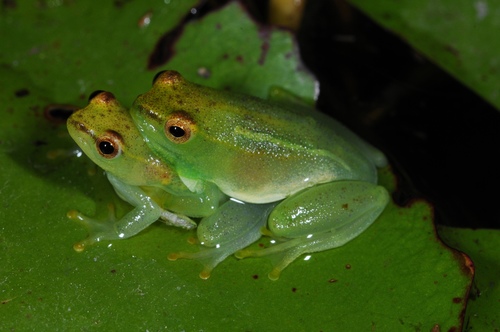
During amplexus, the clasping male triggers the female to begin laying eggs, while the pair's cloacae are held approximately 2 millimetres (0.079 in) apart. The male stays behind the female to fertilize eggs one at a time, and the pair moves frequently to lay between one and fifteen eggs at each new position.
Egg Deposition Details
Eggs are laid at a depth between 1 and 6 centimetres (0.39 and 2.36 in), and sink quickly to the bottom of the water. A single female lays a total of approximately 600 eggs, which hatch after around six days.
Fish Presence Impact on Breeding
The presence of fish in breeding ponds shortens the species' mating period, unlike many other frog species that avoid breeding in fish-containing waters entirely. When the catfish species Clarias gariepinus is introduced, all tested frog species including Kassina senegalensis stop breeding activity immediately.
Tadpole Metamorphosis Period
Tadpoles of Kassina senegalensis take 50–60 days to complete metamorphosis.