About Karsenia koreana Min, Yang, Bonett, Vieites, Brandon & Wake, 2005
Sexual Size Dimorphism
This species, Karsenia koreana, shows no size difference between males and females in snout–vent length, with both sexes measuring between 38.5–47.7 mm (1.52–1.88 in).
Body & Head Structure
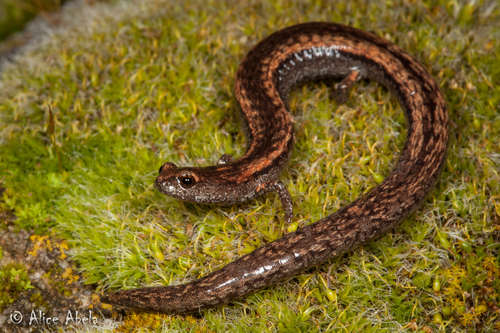
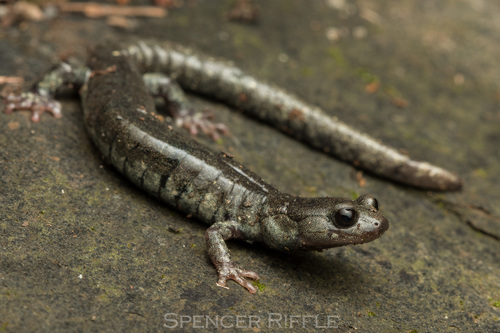
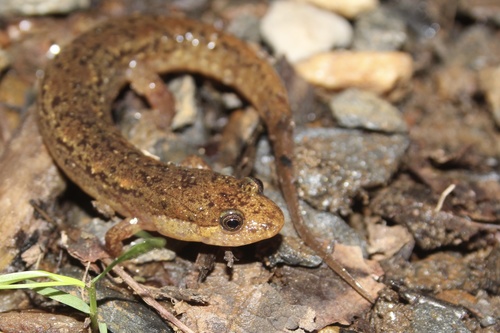
It has a moderately robust body build, a relatively broad head, and small, moderately protruding eyes.
Costal Groove Count
It has between 14 and 15 costal grooves.
Tail Morphology
The base of the tail is round, but in some individuals the tail becomes laterally compressed toward the tip. An intact, non-regenerated tail is roughly the same length as the snout–vent length.
Overall Pigmentation
The species has dark overall pigmentation.
Dorsal Stripe Variation
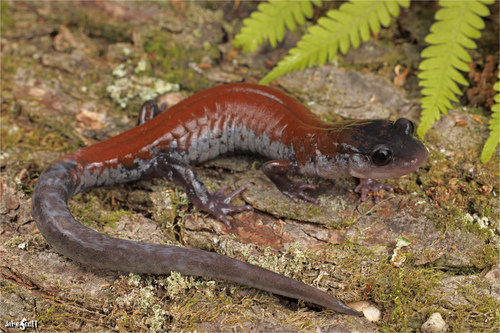
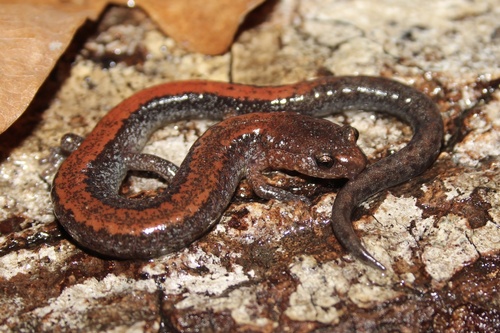
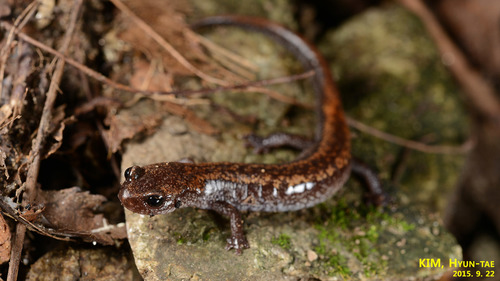
It has a broad dorsal stripe that varies in both color, which can range from reddish to yellowish brown, tan, or dark brown, and in how distinct it appears, from prominent and bright to obscure.
Lateral Body Coloration
The sides of the body are uniformly dark, with a faint overlay of small whitish speckles.
Ventral Body Coloration
The underside of the body is pale, marked with moderately large whitish flecks that are missing along the midline.
Habitat
This species lives on damp talus slopes and limestone rockslides in young forests dominated by Pinus densiflora and Quercus mongolica, where it is found mostly under small stones.
Known Distribution Status
While it is locally common and has a fairly large range, with more than 20 known sites recorded as of 2006, it has not been the subject of extensive field study.
Research Gaps
Because of this, its natural history, population dynamics, and reproductive behavior are still unknown.