About Jasminum sambac (L.) Aiton
Jasminum sambac (L.) Aiton is an evergreen vine or shrub that grows 0.5 to 3 m (1.6 to 9.8 ft) tall. This species is highly variable, which may be caused by spontaneous mutation, natural hybridization, and autopolyploidy. Most cultivated Jasminum sambac plants do not produce seeds, and are entirely reproduced through asexual propagation methods including cuttings, layering, and marcotting.
Its leaves are simple (unlike the pinnate leaves of most other jasmines), with an ovate shape, 4 to 12.5 cm (1.6 to 4.9 in) long and 2 to 7.5 cm (0.79 to 2.95 in) wide. Leaves are arranged opposite each other or in whorls of three. They are smooth and glabrous, apart from a small number of hairs on the veins at the leaf base.
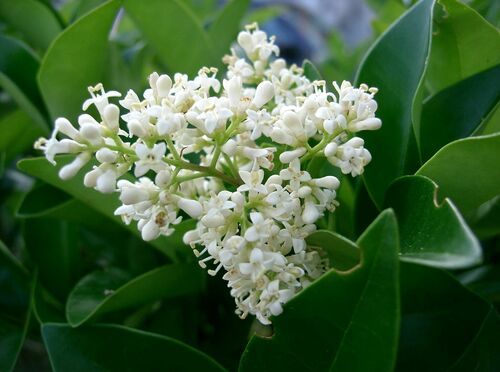
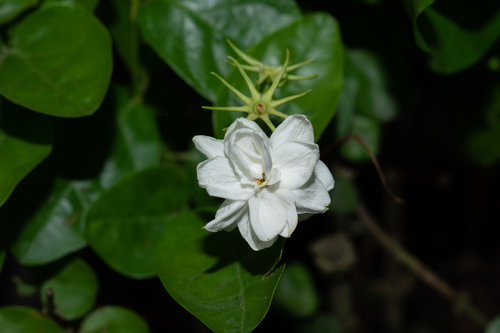
Flowers bloom year-round, growing in clusters of 3 to 12 at the ends of branches. They have a strong, distinct scent, with a white corolla 2 to 3 cm (0.79 to 1.18 in) in diameter that has 5 to 9 lobes. Flowers open at night, usually between 6 and 8 in the evening, and close the following morning, with an open blooming period of 12 to 20 hours. When fruit is produced, it is a purple to black berry 1 cm (0.39 in) in diameter.
The median lethal dose (LD50) of jasmine extract from this species is greater than 5 mg per kg of body weight.
Jasminum sambac is most known for its sweet, heady, intense fragrance. It is widely cultivated across the tropics, ranging from the Arabian Peninsula to Southeast Asia and the Pacific Islands, grown as an ornamental plant and harvested for its strongly scented flowers. Many cultivated cultivars exist today. Flower buds are typically harvested in early morning, selected based on their color, since firmness and size vary with weather conditions. Only white buds are harvested; green buds do not produce the species' characteristic fragrance. Open flowers are not usually harvested, because a greater volume of open flowers is required for oil extraction, and they lose their fragrance more quickly.
Jasminum sambac cannot tolerate freezing temperatures, so in temperate regions it must be grown under glass, in an unheated greenhouse or conservatory. Its intense fragrance may be overpowering for some people. In the United Kingdom, this plant has received the Royal Horticultural Society's Award of Garden Merit.