About Iva imbricata Walter
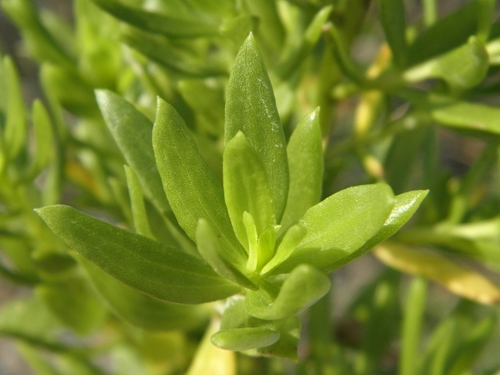
Iva imbricata Walter is a North American flowering plant species in the Asteraceae family, with common names dune marsh-elder and seacoast marsh elder. It is native to Cuba, the Bahamas, and coastal areas of the United States ranging from Texas to Virginia. This plant is a low shrub that grows on sand dunes and upper beaches. It is highly salt tolerant, and often grows as the most seaward perennial plant in its habitat. It is commonly planted along southeastern United States beaches, and is an important species for dune stabilization. It can be easily propagated via cuttings. Iva imbricata sometimes reaches up to 100 cm (40 inches) in height. Its leaves are 1 to 3 mm thick and fleshy, 0.4 to 1.5 cm wide, and 1.5 to 6 cm long. Leaves are glabrous, or strigillose on their surfaces, and have mostly smooth margins. Leaves are typically opposite toward the plant's apex and alternate starting at the midstem. The species grows mostly in maritime environments, including brackish marsh edges, and dune faces and toes. It produces numerous flower heads arranged in elongated arrays. Each flower head contains 2 to 17 disc flowers and no ray flowers. The outer phyllaries form distinct involucres that measure 4 to 7 mm high.