About Iris virginica L.
Morphology
Size and Growth Form
Iris virginica L. is a perennial herb that reaches a height of 0.6–0.9 m (2–3 ft).
Basal Leaf Features
It produces sword-shaped basal leaves that are either erect or sometimes arching; these leaves can grow up to 91 cm (3 ft) long and 2.5 cm (1 in) wide at the base, with smooth margins, a bluish green to green color, and a glabrous (hairless) texture.
Flowering Stalk Characteristics
Flowering stalks grow from the basal leaves, reaching the same total height of 0.6–0.9 m (2–3 ft), and are either unbranched or only sparingly branched.
Stalk Leaves and Pedicels
Small alternate leaves grow along these stalks, and 1 to 2 flowers emerge from the axil of each stalk leaf on 3–13 cm (1–5 in) long pedicels.
Flower Appearance
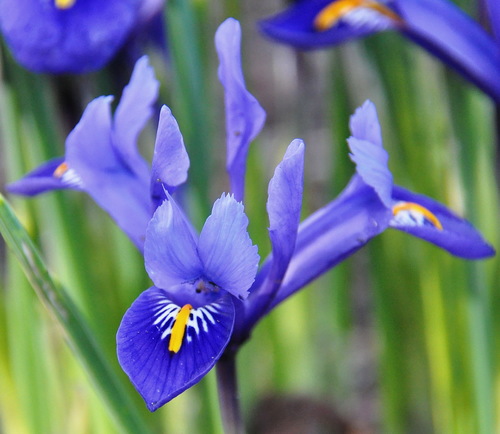
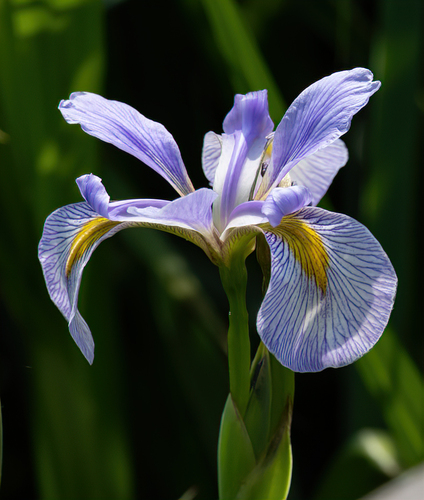
Blooming from May to July, the flowers have a typical iris form, are blue to blue-violet, and measure 3–13 cm (1–5 in) across.
Flower Structure
Each flower has 3 drooping sepals called "falls", which have white markings and yellow coloration near the flower throat, and 3 upright petals called "standards".
Distribution and Habitat
Native Range
Iris virginica is native to North America. In the United States, its native range extends from Nebraska in the west, Florida and Texas in the south, New York in the east, to the Canadian border in the north. In Canada, it is native to Ontario and Quebec.
Habitat Preferences
It grows in wet habitats, sometimes in shallow water, including marshes, wet meadows, swamps, river bottoms, sloughs, ditches, bottomland prairies, and the edges of sinkhole ponds.
Uses and Cultural Significance
Traditional Medicinal Uses
In traditional Cherokee medicine, Iris virginica is used as a medicinal plant. The root is pounded into a paste to make a skin salve. A root infusion is used to treat liver ailments, and a root decoction is used to treat "yellowish urine". It may be one of the Iris species used by the Seminole to treat shock following an alligator bite.
Scientific Significance
It is also one of the three iris species included in Ronald Fisher's Iris flower data set.