About Babiana ambigua (Roem. & Schult.) G.J.Lewis
Growth Form
Babiana ambigua is a perennial plant that emerges from an underground globular corm at the start of its growing season. It is usually 5–8 cm (2.0–3.1 in) tall, and occasionally reaches up to 16 cm (6.3 in).
Corm Tunic Characteristics
Unlike most other Babiana species, the netted, fibrous tunic surrounding the corm does not enclose the stem all the way to the surface and does not form a fibrous collar. The sparsely hairy stem is either completely underground or extends only slightly above ground.
Vegetative Reproduction
This species often produces small corms in underground axils, and rarely forms stolons.
Leaf Morphology
It has hairy, strongly pleated, linear to lance-shaped, more or less upright leaf blades that are 3–15 mm (0.12–0.59 in) wide and grow taller than the inflorescence.
Inflorescence and Flower Color
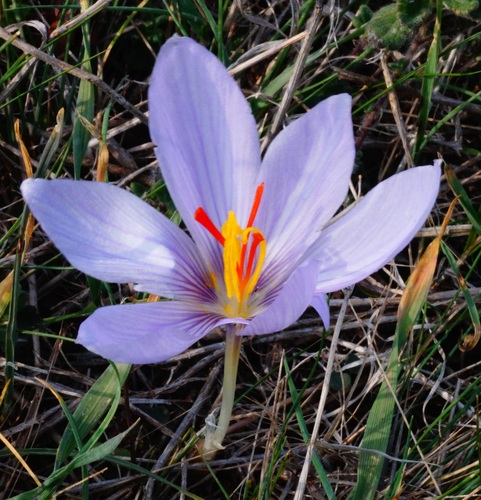
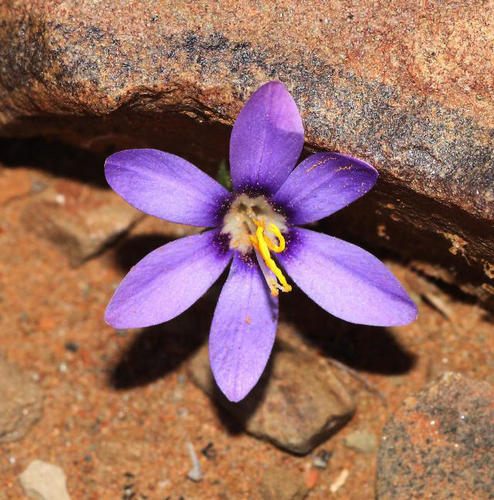
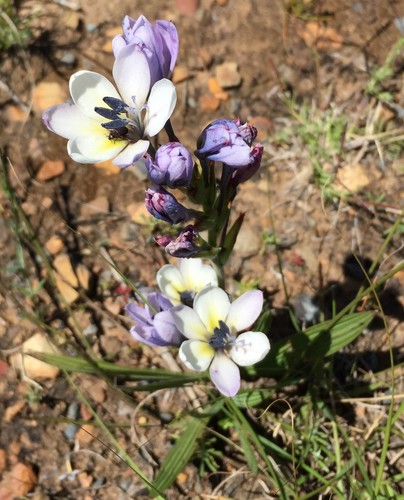
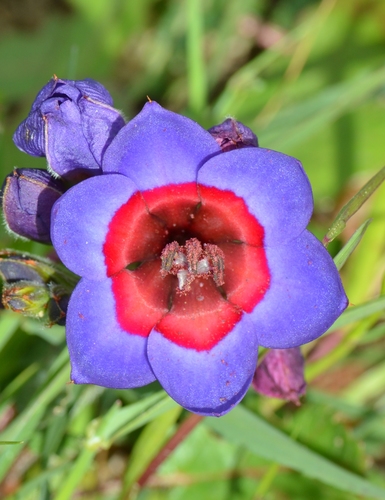
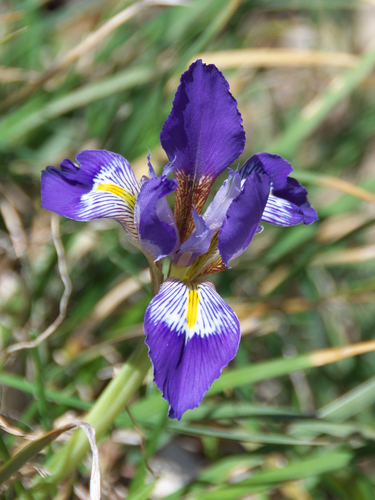
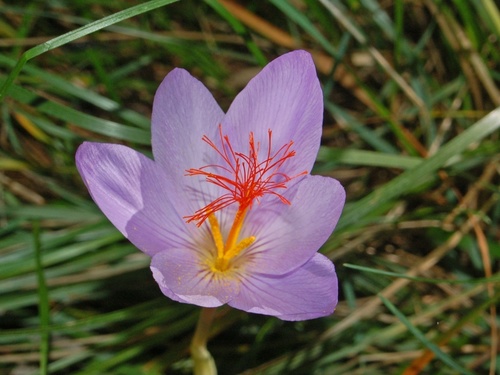
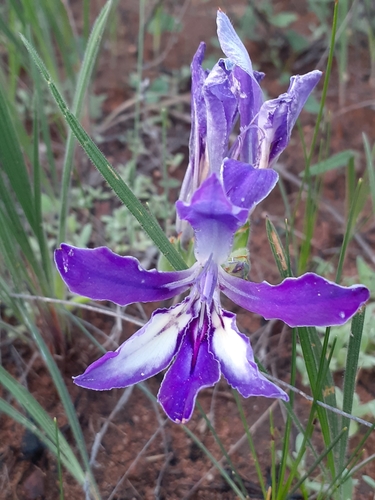
Each inflorescence holds two to four flowers, which range in color from blue to mauve, and are sometimes lilac.
Flower Bracts
Each flower is enclosed at its base by two hairy, green bracts that are 10–30 mm (0.39–1.18 in) long, and can grow up to 40 mm (1.6 in) long; these bracts sometimes have brown tips. The inner bract is as long as the outer bract or slightly shorter, and is split entirely to its base.
Perianth Structure
Each flower has a mirror-symmetrical perianth with a 10–19 mm (0.39–0.75 in) long, funnel-shaped or oblique tube at its base that splits into six unequal tepals near the top. Flowers have a spicy or sweet scent.
Dorsal Tepal Dimensions
The dorsal tepal is larger, at 28–45 mm (1.1–1.8 in) long and 10–12 mm (0.39–0.47 in) wide, and its joint sits 2–4 mm (0.079–0.157 in) higher than the joints between the other tepals.
Lower Tepal Characteristics
The lower tepals are 20–30 mm (0.79–1.18 in) long. The lower lateral tepals have white to cream-colored blotches bordered by intense purple.
Stamen Morphology
The three stamens are crowded close to the dorsal tepal, with curved filaments 13–16 mm (0.51–0.63 in) long, topped by linear anthers 6–8 mm (0.24–0.31 in) long.
Ovary and Style Structure
The ovary is either smooth or has some hairs on the upper end of its ribs, and is topped by a style that divides into three branches at the same level as the anther tips; each branch widens in its upper third.
Species Distribution
Babiana ambigua is distributed across the mountains and coastal belt of South Africa's Western Cape province, between Riversdale in the southeast and the Gifberg in the northwest.
Habitat and Soil Preferences
It grows in fynbos and renosterveld across a range of soil types, including deep coastal sands of strandveld habitat, rocky sandstone mountain slopes and flats, and renosterveld growing on granite-derived soils.
Threats to Subpopulations
Some subpopulations are threatened by urban development in low-lying coastal areas and invasive alien species.
Conservation Status
The species remains common and widespread, with many subpopulations located in protected mountain habitat, so it is classified as a least-concern species.