About Iris spuria L.
Iris spuria L. has a thin, slender creeping rhizome that is fibrous, about 2 cm in diameter. Wiry roots grow beneath the rhizome, and the creeping habit forms compact clumps of plants that can reach over 90 cm (35 in) wide.
It produces erect, slender, sword-shaped, acuminate (pointed) basal leaves that range in color from glaucous green to blue green. The leaves grow between 25–90 cm (10–35 in) long and 5–12 mm wide, and are normally almost as long as the flowering stem. After the plant flowers and sets seed, the leaves die back in late summer.
A strong, erect, round stem grows between 50–80 cm (20–31 in) tall. The stem has 1 or 2 lateral upright branches (pedicels) around 2 cm long, and keeled, lanceolate green spathes (flower bud leaves or bracts) that are 4–8 cm long with a membranous tip. Upper cauline (stem-borne) leaves are shorter than the stem’s internodes. Stems and branches hold 1–4 terminal flowers at the top of the stem in summer, between May and July. They flower after Iris germanica and are similar in form to Iris × hollandica.
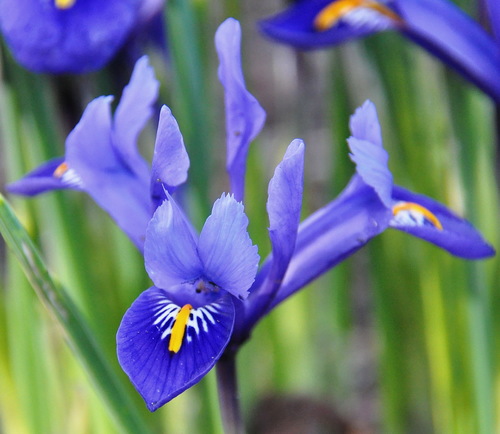
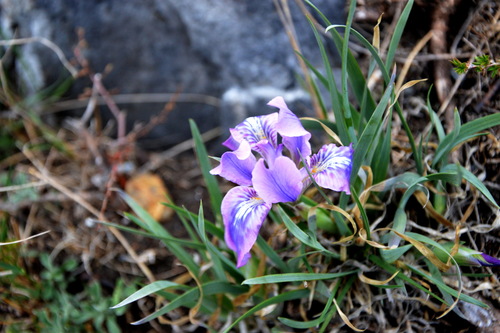
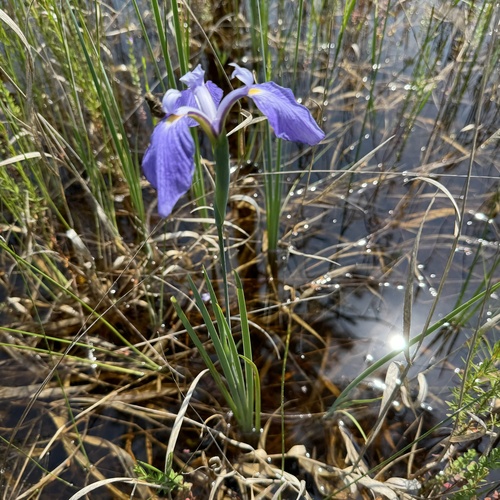
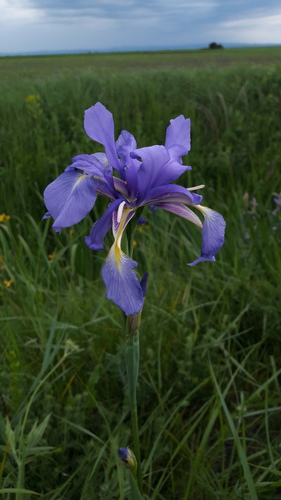
The flowers are large, lightly scented, and up to 6–12 cm (2–5 in) in diameter, coming in shades of lilac, mauve-blue, violet-blue, purple-blue, violet, or blue. There are 2 sets of petals: 3 large outer sepals called 'falls', and 3 smaller inner petals (or tepals) called 'standards'. The falls are broadly ovate, elliptic, or orbicular with a long claw (the section connecting to the stem), measure 4.5–6 cm long and 2.5 cm wide, have purple or violet veining, and a central yellow or white stripe or signal area. The standards are short, lanceolate or oblanceolate, erect and wavy, and measure 3–6 cm (1–2 in) long and 8–20 mm wide. This species has a 7–10 mm long perianth tube, an ovary with a long tapering beak that can reach up to 40 mm long, a narrow violet style, 2.5 cm long violet-lilac stigmas, and 1.27 cm long anthers that match the filament length.
After flowering, it produces an oblong-ovate, hexagonal seed capsule 2.5–4 cm long in September. The capsule has a long beak-like appendage at the top and 6 visible longitudinal grooves. Inside are light brown, angular seeds with a loose membranous testa (seed surface).
Iris spuria is native to a very wide range spanning Africa, temperate and tropical Asia, and Europe. In Africa, it occurs in Algeria. In temperate Asia, it is found in Western Asia’s Afghanistan, Iran and Turkey; Caucasus regions including Armenia, Azerbaijan, Georgia, Ciscaucasia and Dagestan; Russian Siberian regions of Altay, Chelyabinsk, Gorno-Altay, Kurgan, Novosibirsk, Omsk and Tomsk; Middle Asian regions of Kazakhstan, Kyrgyzstan, Turkmenistan, Uzbekistan and Mongolia; and the Chinese provinces of Gansu and Xinjiang. In tropical Asia, it occurs in the Indian subcontinental regions of Jammu, Kashmir and Pakistan. In Europe, it is found in northern Europe’s Denmark and Sweden; central Europe’s Austria, Czech Republic, Slovakia, Germany and Hungary; eastern Europe’s Moldova, Bashkortostan, Ukraine, and Serbia; and southern Europe’s Romania, France and Spain. It has also become naturalized in New Zealand and Lincolnshire, United Kingdom.
Its habitat includes seasonally damp grasslands, damp meadows or pastures, marshes, alluvial plains, swamps, bogs, maquis, salty flats, and saline soils. It also naturalizes in damp grassy areas, beside ditches, on banks, and on roadside verges.
Like many other irises, most parts of the plant (rhizome and leaves) are poisonous. Accidental ingestion can cause stomach pains and vomiting, and handling the plant may trigger skin irritation or an allergic reaction.
Iris spuria is generally considered easy to grow. It is hardy between USDA Zone 3 and Zone 9, and also hardy to European Zone H2. It tolerates most garden soils, including wet soils, saline soils, and saline marshes, and prefers well drained, humus rich soils. It tolerates acid soils but favors neutral soils, and grows best in positions with full sun or partial shade, though shade reduces flowering. It prefers hot, dry summers and only requires abundant water during the spring. Like most species in the Spuria series, it does not tolerate root disturbance. It is best planted from dormant rhizomes in autumn, and planted deeper in soil than Iris germanica. It can be used in garden borders or beds, and as a cut flower for indoor use, and grows into large full clumps of plants.
Two aphid species, Aphis newtoni Theobald and Dysaphis tulipae, can be found on Iris spuria. It is also a host plant for Mononychus punctumalbum, the iris seed weevil, which feeds on iris seeds. The weevil lays its eggs inside the iris’s seed capsule; the larva feeds on the seed and up to 2 other seeds before pupating. Adult weevils emerge from the seed capsules, then fly away to undergo aestivation (summer dormancy) and hibernate in soil.