About Iris tigridia Bunge ex Ledeb.
Rhizome Characteristics
Iris tigridia Bunge ex Ledeb. has small, compact rhizomes that are brown, yellow, or white, and fibrous. Numerous fleshy secondary roots, 3 to 4 mm wide, grow beneath the rhizome. Dense, brown or dark brown fibrous remains of last season’s leaves sit on top of the rhizome, forming small tufted plants.
Leaf Size Range
Its leaves are dark green or greyish green, growing between 5 and 30 cm (2 and 12 in) long and 1.5 and 6 mm wide. When flowering starts, leaves are 5–13 cm (2–5 in) long and 1.5 to 2 mm wide, and elongate later to reach a final maximum height of 30 cm.
Leaf Morphology
Leaves are grass-like, and can be erect and linear or slightly curved. They lack a midvein and have a pointed (acuminate apex) tip; this form distinguishes them from Iris potaninii. In mild temperate regions, the leaves stay green through winter (evergreen).
Stem Characteristics
The plant produces a slender stem that grows between 3 and 15 cm (1 and 6 in) tall, and sometimes the stem barely appears above ground. The stem holds two yellow-green, membranous (scarious) spathes, which are flower bud leaves. The spathes are lanceolate, 3 to 4 cm (1 to 2 in) long, with a pointed tip.
Flowering Period
Stems bear one (rarely two) terminal flowers at the top of the stem, which bloom between April and May, most often in May.
Flower Appearance
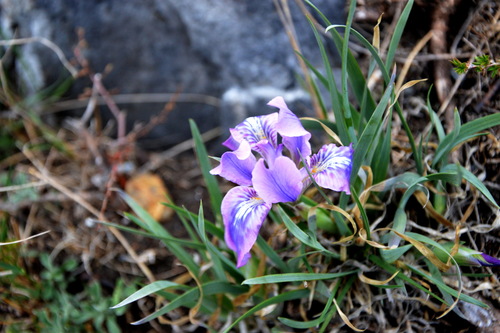
Flowers are 3.5–5 cm (1–2 in) in diameter, and come in shades of violet, dark blue, blue-purple, dark purple, mauve, lilac, lavender, or light purple, with darker spots, veining, or mottling. Like other irises, it has two pairs of petals: three large outer sepals called falls, and three smaller inner petals/tepals called standards.
Fall Petal Features
Falls are obovate, 3–4 cm (1–2 in) long, and 1–1.5 cm wide. At the center of the fall there is a white patch and a beard, with blue-white or white hairs tipped with yellow, or all yellow hairs.
Standard Petal Features
Standards are oblanceolate, either erect or tilted outwards, 2.5–3 cm long, and 0.4–0.7 cm wide. They are a darker shade than the falls.
Flower Reproductive Parts
The plant has a 5 mm long pedicel, and a 2 cm long perianth tube that widens at the top. It has 2.3–2.5 cm long styles with triangular crests, blue pollen, a long green ovary up to 1.2 cm long, and 1.5 cm long stamens.
Seed Capsule Traits
After flowering, between June and July (or up to August), the plant produces an ovoid or spindle-shaped (fusiform) seed capsule 2.5 to 4 cm (1 to 2 in) long and 1.5 to 2 cm in diameter. A beak-like tip remains attached to the top of the capsule from the perianth tube.
Seed Characteristics
Inside the capsule are roundish or pear-shaped (pyriform) seeds, which have a creamy or yellowish white appendage called an aril.
Native Distribution Range
Iris tigridia is native to temperate Asia, and is endemic to northeast Asia, ranging from the Altai mountain range and Siberia to Manchuria in China.
Russian Distribution
It is found in Russia, in the Russian states of Aga-Buryat, Buryatia, Chita, Chukchi, Gorno-Altay, Irkutsk, Magadan, Tuva, and Yakutia (Sakha), including the Altai Mountains, Altai Republic, and the Trans-Baikal region (Khentei-Daur Highlands).
Central Asian Distribution
In middle Asia it occurs in Mongolia (in the territories of Khubsugul, Khentei, Khangai, Mongol-Daurian and Middle Khalkha) and in Kazakhstan.
Chinese Distribution
It also grows in China, in the provinces of Gansu, Heilongjiang, Jilin, Liaoning, Nei Monggol, Qinghai, Shanxi, and Sichuan.
Altai-Sayan Co-Occurring Species
It is recorded as occurring in the Altai-Sayan region (where Russia, China, Mongolia and Kazakhstan meet) alongside Iris bloudowii, Iris glaucescens, Iris ruthenica, Iris sibirica, Iris tenuifolia, and Iris psammocola (another Pseudoregelia Iris).
Habitat Types
It grows on rocky or gravelly screes, dry hillsides or slopes, in dunes, sandy meadows or grasslands, steppes, and beside forest margins.
Altitude Range
It can be found at altitudes between 0 and 2,000 m (0–6,562 ft) above sea level.
Toxicity Risks
Like many other irises, most parts of the plant (rhizome and leaves) are poisonous. If mistakenly ingested, it can cause stomach pains and vomiting. Handling the plant may also cause skin irritation or an allergic reaction.
Hardiness Rating
In Europe, it is hardy to Zone H3, meaning it tolerates temperatures between −10 and −15 °C (14 to 5 °F). In regions where it is not hardy, it can be grown in an alpine house or bulb frame, since it needs protection from winter moisture.
Russian Hardiness Testing
Its hardiness has been tested in Russia at the botanical gardens of Barnaul (South-Siberian Botanical Garden), Novosibirsk (Central Siberian Botanical Garden), Chita (Trans-Baikal Botanical Garden), and Saint Petersburg Botanical Garden. It was found to be not hardy only in St. Petersburg.
Cultivation Requirements
It grows best in well-drained soils in a sunny position, and is suitable for growing in a rock garden. It is thought best planted between August and September.
Human and Agricultural Uses
It is used in gardens, in herbal medicines, and as a fodder plant for farm animals. Cattle and horses eat it at most times of year. Goats also consume it, but it is considered an undesirable food source for them.