About Iris sanguinea Hornem.
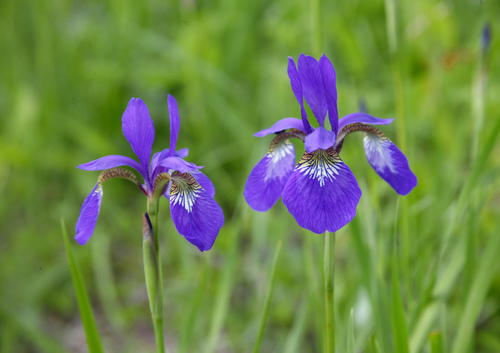
Iris sanguinea Hornem. has a thick, creeping rhizome. Its leaves are grey-green, and are roughly the same height as the plant’s flowering stems, but appear shorter because they droop. The leaves are linear and narrow, growing between 20 and 60 cm long, and 5–13 mm wide. Its flowering stem is hollow and unbranched, and reaches between 30 and 90 cm (12 and 35.5 in) long. Each stem holds two to three flowers at its terminal end, which bloom in early summer between May and July. The plant produces three green spathes (bud leaves), which are reddish at the base, 5–7 cm long, 1 cm wide, and end in a brown papery tip. Flowers can come in a range of reddish-purple shades including blue, blue-purple, and red-violet, with very rare white variants. The flowers measure 6–8 cm in diameter. It has two pairs of petals: three large outer petal-like sepals called ‘falls’, and three smaller inner petals or tepals called ‘standards’. The large egg-shaped, drooping falls have reddish-purple veins over a white or yellowish signal patch. The smaller, erect egg-shaped standards are 4–5 cm long and 1.5 cm wide. It has a perianth tube 8–10 mm long, 3 cm long white filaments, yellow anthers, a cylindrical ovary 1.5–2 cm long by 3–4 mm wide, and reddish-purple style branches 3.5 cm long by 5 mm wide. After flowering between July and September, it produces a seed capsule that is ellipsoid or cylindrical in shape, and measures 3.5–5 cm long by 1.2–1.5 cm wide.
Iris sanguinea is native to temperate regions of eastern Asia. It is found in Russia (in areas east of Lake Baikal in Siberia, including Buryatia, Chita, Irkutsk, Amur, Khabarovsk, Magadan and Primorye), Mongolia, China (in the provinces of Heilongjiang, Jiangsu, Jilin, Liaoning and Nei Monggol), Japan (on the islands of Hokkaido, Honshu and Shikoku), and Korea. It grows in damp meadows, along the edges of rivers, lakes, and forests, beside streams, and on hillsides, at altitudes around 500 metres above sea level.
Like many other irises, most parts of Iris sanguinea (especially the rhizome and leaves) are poisonous. Accidental ingestion can cause stomach pain and vomiting, and handling the plant may lead to skin irritation or an allergic reaction.
Iris sanguinea is considered easy to grow. It is sometimes described as prolific, meaning it can become invasive when growing conditions are optimal. It tolerates temperatures from −3.8 °C (25.2 °F) down to −34.4 °C (−29.9 °F). It is hardy in USDA Zones 4–9, and in Europe it is classed as hardy to Zone H2 (hardy to between −15 and −20 °C (5 to −4 °F)). It is hardy in the UK, but will not survive wet winters in cooler regions of the world. It should be grown in well-drained, neutral to slightly acidic soils with a pH above 5.6, that contain plenty of organic matter or are loam-based. It prefers full sun, but can tolerate partial shade as long as it gets some hours of sunlight each day. The plant requires moisture during the growing season in spring and early summer to produce its best blooms. It does not grow in standing water, though it can tolerate occasional flooding.