About Iris rossii Baker
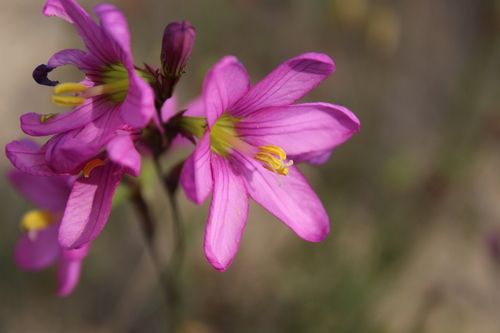
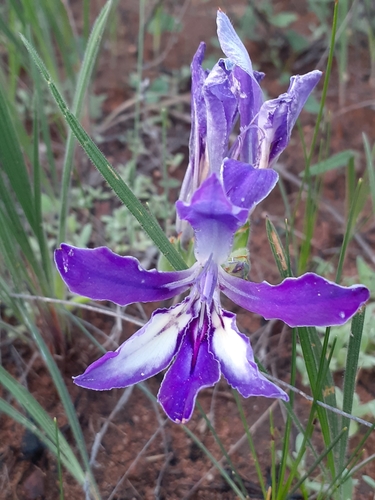
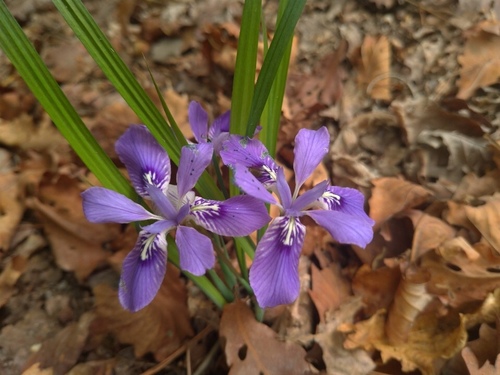
Iris rossii Baker is similar in form to Iris ruthenica. It has slender, tough, reddish-brown creeping rhizomes. Long secondary roots grow downward from the rhizome into soil to absorb nutrients and water. Yellow-brown remnants of previous seasons' leaves (sheaths or fibres) are found at the base of new leaves. This species produces narrow, linear, acuminate (pointed, grass-like) leaves that are 4–10 cm (1+1⁄2–4 in) long and 2–5 mm (1⁄16–3⁄16 in) wide when young, with 2–4 visible veins. Leaves elongate after flowering, reaching up to 30 cm (12 in) long. Dwarf, short stems (scapes) grow between 10–30 cm (4–12 in) long, holding 2 or 3 lanceolate (lance-shaped) spathes (flower bud leaves) that are 4–7 cm (1+1⁄2–3 in) long and 1–4 mm (1⁄16–3⁄16 in) wide. One or two terminal flowers (borne at the top of the stem) bloom from spring to early summer, between April and May. The small flowers measure 3.5–4 cm (1+3⁄8–1+5⁄8 in) in diameter, and most display shades of purple and violet; white forms occur occasionally, and these white forms are only found in Korea. Like other irises, it has two pairs of petals: three large outer sepals called 'falls', and three smaller inner petals (or tepals) called 'standards'. The falls are obovate, 3 cm long and 0.8–1.2 cm wide, marked with white spots, veins, or a white signal area, with a white or yellow centre section. The standards are erect or slightly angled, 2.5 cm long and 0.8 cm wide. The flower has a 5–7 cm long perianth tube, a 1 cm long pedicel, slender 1.5 cm long stamens, a 1 cm long ovary, and 2 cm long style branches that match the petal colour. After flowering, it produces a spherical (globose) seed capsule between June and August.
Iris rossii is native to Japan (Honshu, Shikoku, and Kyushu), Korea, and China (Liaoning and Manchuria). On 29 April 1894, explorer Isabella Bird Bishop recorded finding Iris rossii alongside Acanthopanax ricinifolia, Rhus vernicifera, and Actinida pueraria while surveying vegetation in valleys along both sides of the River Han in Korea. It was originally thought to occur only in the north-eastern Chinese portion of the Korean Peninsula, before being first discovered in Hojo, Ehime Prefecture, Japan. It was later recorded in other Japanese regions, including the prefectures of Saga, Oita, Miyazaki, Yamaguchi, Hiroshima, and Okayama, as well as woodland in Nutanishi-chō, Mihara, Hiroshima.
It grows in meadows and grasslands at forest margins, on sunny hillsides, and in clearings within pine woods, at altitudes of 100 metres above sea level.
Like many other irises, most parts of Iris rossii (especially the rhizome and leaves) are poisonous. Accidental ingestion can cause stomach pain and vomiting, and handling the plant may lead to skin irritation or an allergic reaction.
Iris rossii is hardy in the United States and the United Kingdom, but it is rare in cultivation. It prefers well-drained, nutrient-rich soils, grows best in full sun positions but tolerates shade, and is highly drought-tolerant, making it suitable for xeriscaping. It can be planted on alpine scree slopes and in rock gardens.