About Iris pumila L.
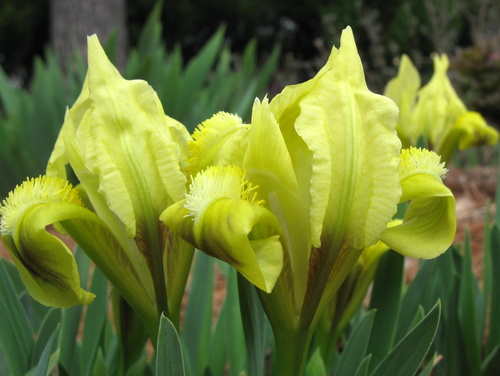
Iris pumila, which is sometimes called pygmy iris or dwarf iris, is thought to have originated as a natural hybrid between Iris pseudopumila Boissier & Heldreich and I. attica Tineo. Its distribution extends from Austria through eastern Europe and the Balkans, across Eurasian steppe regions in Ukraine, southern Russia into southern Siberia and northern Kazakhstan, and from the Caucasus into Turkey. Iris pumila can be distinguished by its single blooms, which sit 10–20 cm above ground level on a lengthened perianth tube; the ovary rests almost directly on the rhizome, on a very short stem. The flower is protected by two spathes, both of which are round in cross-section. Flower color varies widely: yellow and purple or violet are the most common, but blue, cream, white, and blended colors are also found frequently. Most forms have a darker spot on the flower falls. Starting in the mid-20th century, Iris pumila was extensively cross-bred with hybrid garden tall bearded irises, which produced the wide variety of modern dwarf and median bearded iris cultivars that exist today. Another known hybrid involving pumila is 'Iris coerulea', which was named by Édouard Spach in Hist. Veg. Phan. xiii. 50 in 1846.