About Iris pontica Zapal.
Iris pontica Zapal. is known as the smallest Spuria iris. It is related to Iris sintenisii and Iris graminea, but is very distinct from these two species.
Rhizome Features
It has short, thick, woody, branching rhizomes that measure 0.4–1.0 cm in diameter, and normally grow 3–5 cm deep in the soil. Their branching, creeping growth habit creates tufts of plants.
Leaf Characteristics
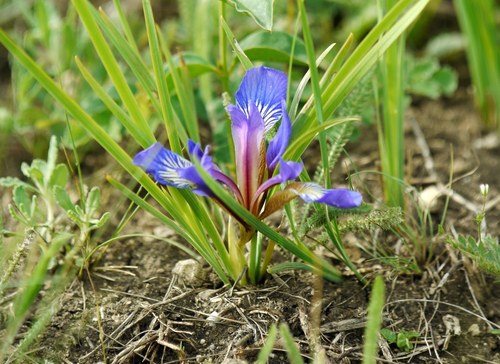
Its foliage is similar in form to that of Iris graminea. It produces 2–5 basal leaves that are narrow, linear, lanceolate, slightly glaucous and grass-like. The leaves grow up to 10–45 cm (4–18 in) long and 2–5 mm wide, and can be 3 times as long as the stem. They have prominent ribs or veining.
Stem Dimensions
It has a very short stem that is just 1–4 cm long. Including the flower, peduncle and stem, the plant can reach a total height of up to 10 cm (4 in).
Flowering Period
The stems or peduncles hold 1 (rarely 2) terminal flowers in late spring or early summer, between April and June. The stems have 2 green, lanceolate, membranous spathes, which are the leaves of the flower bud, that measure 40–70 mm long.
Flower Traits
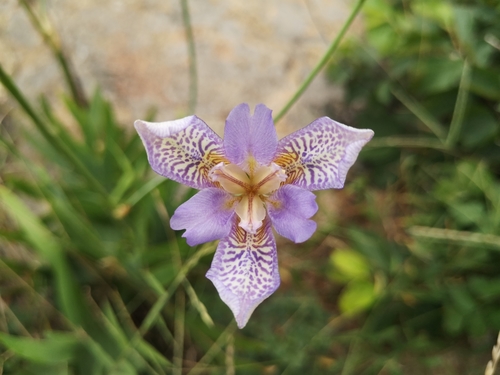
The flowers have a slight scent, which is rare for most spuria irises. They can reach up 5–7 cm (2–3 in) in diameter, and come in shades of violet-blue, violet, purple, or purple-reddish.
Petal Structure
It has 2 pairs of petals: 3 large outer petals called sepals, known as 'falls', and 3 smaller inner petals or tepals, known as 'standards'. The falls are sub-orbicular or obovate, and have a yellow, yellow-greenish or white centre patch that is veined with violet, reddish-brown or brown. They have very narrow dark purple claws, the section closest to the stem, measuring 45–55 mm long and 15–18 mm wide. The single-coloured (violet-blue to blue) standards are oblanceolate and unguiculate, or claw-shaped. They also have dark purple claws that are 35–50 mm long and 8–12 mm wide.
Perianth Tube
It has a long perianth tube, which is difficult to measure because of the plant's slender, beaked ovary. It is estimated to be between 2 and 5 cm long.
Reproductive Parts
It has a bronze-purple or purple carinate (ridged), recurved (upturned at the front edge) style branch that has two violet-blue teeth. It also has a 2-lobed stigma, yellow filaments, azure anthers and a cylindrical ovary.
Seed Capsule
After flowering, it produces an ellipsoid seed capsule between May and August that is 1.5–2.5 cm long and has 6 ridges. Inside the capsule are reddish brown to brown pear-shaped (pyriform) or globose seeds, which have a papery testa (coating).
Native Range
Iris pontica is native to eastern regions of Europe and Russia. It is found in eastern Europe within Moldova, Romania, Ukraine, and north eastern Turkey. It also occurs in the Caucasus region, which is part of the Russian Federation, formerly the USSR. As recently as 2013, the species was first discovered in the forest-steppe area of Moldavia.
Habitat
It grows on dry sunny grasslands and meadows of steppes, and on limestone, chalky and granite mountain slopes, along the edges of ravines. It can also be found in thickets of shrubs and at the edges of forests. Sometimes, it is difficult to spot because its flowers are hidden by the leaves.
Cultivation Hardiness
It is hardy to European Zone H2, and hardy enough to be grown in Moscow, Saint Petersburg and Stavropol in Russia. It has grown well for up to 12 years in the St Petersburg Botanical Garden.
Soil Preferences
It prefers to grow in soils that contain limestone, but is tolerant of other soils including rich clay loams, neutral dry soils, or a peat bed composed mainly of leafmold and rotting wood.
Light Requirements
It prefers full sun or partial shade, and is classified as a heliophytic species.
Cultivation Uses
It can be grown in a rock garden, an alpine house, or in a container or pot. It is rarely seen in the UK.