About Iris dichotoma Pall.
Rhizome and Root Structure
Iris dichotoma Pall. grows from a small, stout, very short fibrous rhizome, with thick, swollen roots growing beneath the rhizome.
Basal Leaf Appearance
It produces numerous basal leaves that grow from the base of the rhizome; the leaves are typical iris-shaped, fan-shaped, sword-shaped, greyish green, and slightly curved. Their form is similar to the leaves of bearded irises and also resembles the leaves of Vanda orchids.
Basal Leaf Dimensions and Venation
The leaves have no midvein, and grow 15–35 cm (6–14 in) long and 1.5–3 cm (1–1 in) wide.
Stem Characteristics
The plant produces dichotomously or multi-branched stems that grow 90–120 cm (35–47 in) tall, holding flowers far above the leaf foliage.
Stem Spathe Features
The stems carry 4 to 5 green, lanceolate (spear-shaped) leafy spathes (flower bud leaves) that measure 1.5–2.3 cm long.
Bloom Period
In the United States, it blooms from May to midsummer; in other regions, it blooms in summer or late summer, between July and early August.
Common Name Origin
Unusually, it opens its flowers in the late afternoon around 3 to 4 o'clock, which aligns with the time of Christian Vespers services, giving it the common name 'Vespers iris'.
Flower Longevity and Shedding
Flowers fully open in just a couple of minutes, but only last one day: after dark, they twist into tight small spirals and drop from the stem, so withered flowers are almost never seen on the stems.
Flower Production Volume
Each stem holds between 3 and 6 flowers, while well-established plants can produce nearly hundreds of flowers, with the overall flowering display lasting 3 to 4 weeks.
Pollination
The flowers are fragrant, and their nectar is extremely attractive to hummingbirds and honeybees, enabling cross-pollination and seed production.
Flower Size and Color Range
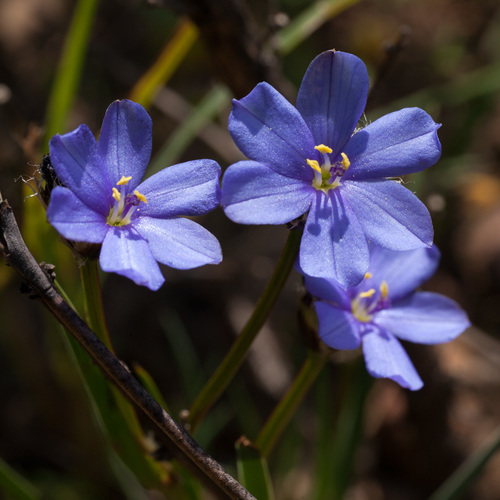
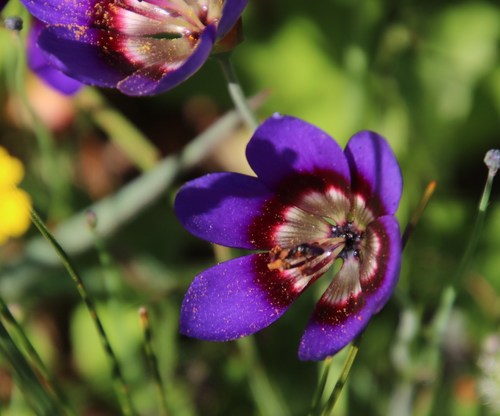
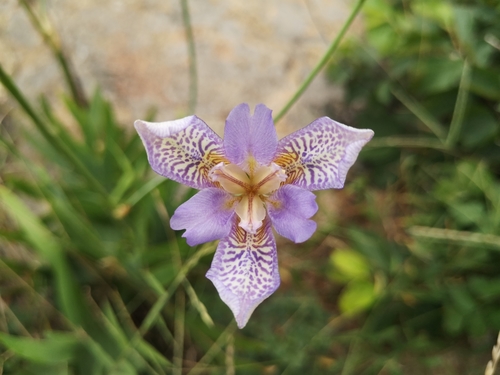
The flowers are small, about 1 inch (25 mm) long, and come in shades of violet, mauve, purple, lavender, pale blue, and (rarely) white, cream, or pink.
Petal Structure Terminology
Like other irises, it has two pairs of petals: three large outer sepals called 'falls', and three smaller inner petals (or tepals) called 'standards'.
Outer Fall Shape and Size
The outer falls are broadly oblanceolate (much longer than wide, with the widest section near the tip), 3–3.5 cm long and about 1 cm wide.
Outer Fall Markings
The 'claw' (the section of the fall closest to the flower center) is striped or reticulated (grid-marked) with yellowish brown; the limb (outer end portion) has darker spots over a central pale patch.
Outer Fall Patch and Spot Variation
This patch may be whitish with a green tint, and the spots can be lilac-mauve, brown-purple, or red-purple. The tips of the falls have no spots or markings.
Inner Standard Characteristics
The plain inner standards are narrowly obovate (teardrop-shaped), 2.5 cm (1 in) long and 6–8 mm wide, with a retuse apex (a rounded end with a slight depression).
Style Arm Features
The flower has very distinct style arms that are 2.5 cm (1 in) long with purplish brown markings.
Perianth Tube and Reproductive Organs
Its perianth tube is extremely short or entirely absent. It has stamens 1.6–1.8 cm long, and a 1 cm long green ovary.
Fruiting Period
After flowering, between August and September, the plant produces a seed capsule and seeds.
Seed Capsule Dimensions
The seed capsule is cylindrical, yellowish-green, 3.5–5 cm long and 1–1.2 cm wide.
Seed Characteristics
Inside the capsule are elongated or elliptic brown or dark brown seeds that have small wings; this differs from Iris domestica and related hybrids, which have large, round, black seeds.
Native Range
Iris dichotoma is native to temperate regions of Asia. It is found in Siberia near Lake Baikal and the Dahuria region, near the Russian city of Chita, in Russia's Amur Oblast, and also in Mongolia, Korea, and the Chinese provinces of Anhui, Gansu, Hebei, Heilongjiang, Henan, Hubei, Hunan, Jiangxi, Jilin, Liaoning, Nei Mongol, Ningxia, Shaanxi, Shandong, Shanxi, and Yunnan.
Habitat and Altitude
It grows in oak (Quercus) forests, sandy grasslands, and dry sunny areas with moist fertile soils, at altitudes between 200 and 2,300 m (660–7,550 ft) above sea level.
Toxicity
Like many other irises, most parts of Iris dichotoma are poisonous, especially the rhizome and leaves. Accidental ingestion can cause stomach pain and vomiting, and handling the plant may lead to skin irritation or an allergic reaction.
Cultivation Suitability
Iris dichotoma is difficult to cultivate, and is generally considered a collector's plant rather than a good choice for amateur gardeners. Many gardeners treat it as a biennial, as it can be fairly short-lived, especially hybrid forms.
Cold Hardiness
It is hardy in USDA Zones 6 to 10, and can withstand temperatures down to between −23.3 °C (−10 °F) and −20 °C, and requires no winter protection when grown in Pittsburgh.
Soil Requirements
It prefers well-drained, humus-rich garden soil, and tolerates neutral to acidic soils with a pH between 6.5 and 7.5.
Sun and Watering Needs
It grows best in full sun positions, and needs consistent watering and fertilization, especially to produce flowers in its first summer. It is drought-tolerant once established, though it still prefers regular watering.
Garden Companion Planting
In gardens, it can be planted in July alongside trumpet lilies (Lilium brownii, Lilium henryi, Lilium regale) or Galtonia candicans in a white garden. It can also be paired with other evening-blooming plants like Cestrum and Jasminum in a night garden, or with morning-flowering Hemerocallis (daylilies) to create a 'lauds and vespers' planting section in a garden.
Medicinal Uses
In Chinese herbal medicine, Iris dichotoma is used to treat multiple disorders including inflammation, throat disorders, asthma, and coughs.