About Iris lortetii Barbey
Iris lortetii Barbey is thought to resemble several other irises including Iris sari, Iris gatesii, and Iris susiana, and some have called it perhaps the most beautiful iris in the world. It has a short, stout, brown and fibrous rhizome that grows just below the soil surface, forming small complex networks. Its leaves are grey-green, straight and sword-shaped. Individual leaves can reach 18–23 cm (7–9 in) long and 1–2 cm (0.39–0.79 in) wide. These leaves are larger than the leaves of the regionally sympatric Iris susiana, and they hide the flower stem. Iris lortetii is deciduous, and disappears completely during its winter dormancy period.
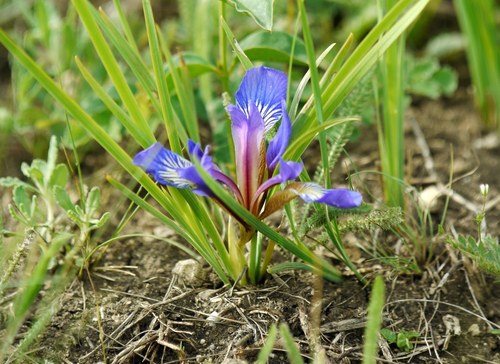
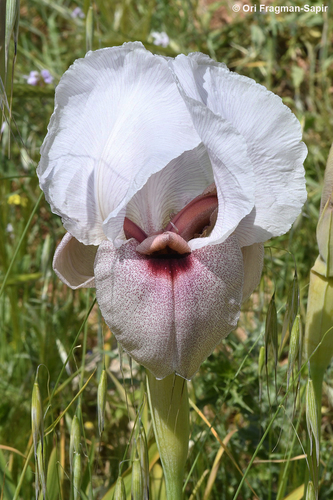
Its flowering stem grows 30–50 cm (12–19.5 in) tall. It bears spathes 12.5 to 15 cm (5 to 6 in) long with lanceolate, pale green valves. A single solitary flower is produced per stem, blooming between April and May, in late spring or mid-summer. The large flowers are 7–9 cm (3–3.5 in) in diameter, very large, showy, and variable in color. They can range in shades of pink, from white, to lilac, pale lavender, and grey-purple.
Like other irises, it has two pairs of petals: three large outer sepals called 'falls', and three smaller inner petals or tepals called 'standards'. The falls are oblong-obovate shaped and recurved (bent backwards), with maroon, brown, or crimson, lilac to pink dots and veins over a pale blue, lavender, pale cream or yellowish base. It has a small deep maroon signal patch in the center of the falls, and a sparse row of short hairs called the 'beard', which is brown, purple-brown or reddish in color. The paler standards are orbicular shaped, with pale lilac veins over a nearly white base. It has a purplish-brown style with reddish brown lobes, and a 4 cm (1.5 in) long perianth tube. After flowering, it produces a seed capsule. Its seeds are both pollinated and dispersed by ants.
Iris lortetii is native to temperate Asia. It is endemic to Israel, Palestine, southern Lebanon (south of the Litani River), and Syria. Within Israel, it occurs in the Upper Galilee, Mount Gilboa, Samarian mountains, and the Samarian desert. It grows in well-drained stony terra rossa, or on rocky limestone slopes within open shrubland, and sometimes grows in rock crevices on limestone cliffs. It can also grow in pine forests, or Mediterranean woodlands and shrubland, and is found at altitudes of 200–1,000 m (660–3,280 ft) above sea level.
Like many other irises, most parts of this plant (the rhizome and leaves) are poisonous. If mistakenly ingested, it can cause stomach pains and vomiting. Handling the plant may also cause skin irritation or an allergic reaction.
Iris lortetii is considered one of the most difficult irises in its class to cultivate. It is hardy to European Zone H4, and USDA Zones 2 to 9. It prefers part shade to full sun, and slightly acidic soils with a pH between 5 and 7.5 that are a mix of sand and clay. Like many other irises, it should be kept moist during its growing period but kept completely dry during winter dormancy, and should not be given high-nitrogen fertilizer. In regions where it is not hardy, rhizomes can be stored in late summer and fall at 23 °C to mimic the hot, dry conditions of its natural Mediterranean habitat. However, rhizomes lose between 30 and 60% of their weight during this storage. The aphid Dysaphis tulipae is known to infest this plant.
Soon after it was discovered in 1882, large numbers of rhizomes were collected for commercial cultivation in Israel, and exported to Europe for the ornamental plant trade. Cultivated specimens rarely survived more than two growing seasons, which created a continuous demand for newly collected wild plants and rhizomes. It was also collected extensively for the cut flower industry, and sold in bunches roadside. Plants were also moved from the wild to decorate local area cemeteries. It is still available locally for sale as a garden plant in Upper Galilee, Israel.