About Iris hermona Dinsm.
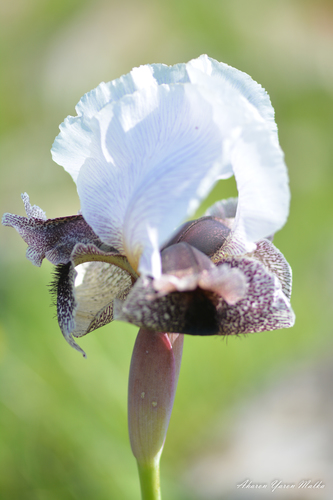
Iris hermona Dinsm. is a geophyte with a stout, compact rhizome. This trait distinguishes it from Iris bismarckiana, another Oncocyclus Iris that shares similar flower shape and other morphological features but has a stoloniferous rhizome. It produces nine linear, straight, erect leaves, which differ from the short, curved leaves of another Oncocyclus Iris, Iris westii. The leaves can reach 30 cm in length and 1.8 cm in width. It has a slender stem, or peduncle, that grows between 30 and 50 cm tall. The stems bear terminal flowers that bloom early in the season, between March and April, or between April and May when grown in the UK. The flowers have a diameter of 10 to 18 cm, and are considered the largest single flowers found in Israel. They are bi-coloured, with a base background of pale lilac, creamy, cream-yellow, light tan, or white, and are covered in purple-brown, purple, or purple-pink veining, spots, or speckling. Like all irises, it has two pairs of petals: three large outer sepals called falls, and three smaller inner petals (or tepals) called standards. The falls are obovate and very recurved, measuring 6.5–8.5 cm long and 4.5–6.5 cm wide. The colour and thickness of the falls' veining or speckling can vary. In the centre of each fall is an orbicular signal patch that is purple-brown or almost black, and 1.2 cm long by 1.5 cm wide. Also in the middle of each fall is a row of short hairs called a beard, which is sparse, and made up of purple-brown or almost black hairs. The standards are sub-orbicular, measuring 6.4–8.5 cm long and 5.5–7.5 cm wide, and are paler than the falls. It has cream or yellow anthers with purple filaments, and creamy white style branches. Compared to Iris atropurpurea and Iris haynei, it has a very short flowering period of 3.6 ± 0.8 days. After flowering, it produces a seed capsule that has not yet been formally described. It is native to temperate western Asia, and is endemic to Israel (including the Golan Heights, Keshet, and Mount Hermon) and Syria. It grows in open locations including pastures, the edges of oak scrub, steppes, and rocky meadows, on heavy soils such as rocky basalt, heavy basalt soils, or dark brown limestone soils. Like most Oncocyclus irises, Iris hermona is pollinated by night-sheltering male eucerine bees. Like many other irises, most parts of this plant (especially the rhizome and leaves) are poisonous. Accidental ingestion can cause stomach pains and vomiting, and handling the plant may lead to skin irritation or an allergic reaction. Iris hermona is thought to be easier to grow in cultivation than other related irises, because it can tolerate a Mediterranean climate. In general, Oncocyclus Section irises require good drainage, minimal summer rainfall, and dry winters, conditions similar to a semi-arid climate. In temperate regions such as Europe and North America, they are only suitable for cultivation by specialist iris growers, grown inside a bulb frame or greenhouse. They can be grown under glass in frames to protect them from excess moisture, especially during winter, and to ensure that shallow-planted rhizomes receive the best temperatures during the growing season. They can be grown in pots, particularly deep pots called long toms, but they require re-potting every two years and additional feeding. Watering is one of the most critical aspects of cultivating this iris. It can be affected by aphids, viruses, and rots. Israel's national collection of Oncocyclus irises is held at Ramat HaNadiv, the burial place of Baron Edmond de Rothschild (1845–1934). The site hosts an iris garden that includes I. hermona, Iris mariae, Iris atropurpurea, and other Oncocyclus irises, along with a large propagation system for growing more irises.