About Iris grant-duffii Baker
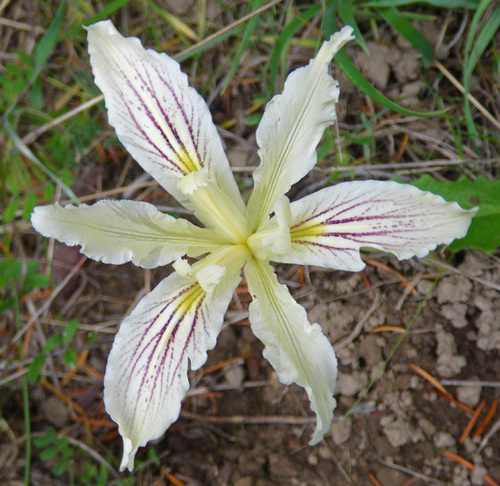
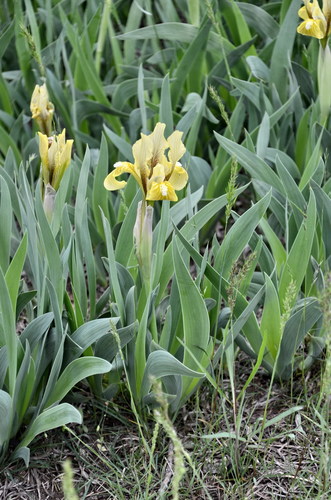
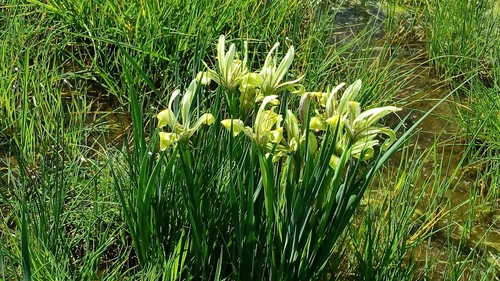
Iris grant-duffii Baker is similar in form to two North American iris species: Iris tenax and Iris douglasiana. Its seedlings produce a small rhizome bud with a form intermediate between a tuber and a bulb. In the first year of growth, this seedling bud resembles the bulb of Iris reticulata. Over time, the bud develops into a short, stubby rhizome. The rhizome is structured in growth bands, with each band formed by one growing season. Each growth band retains the remains of the previous season's leaves, which become very spiny. This spiny texture makes handling the rhizomes very difficult and painful. These brown bristles or spines are thought to protect the plant from grazing by animals. Over time, the creeping rhizome forms large clumps of plants. The leaves are greyish green, slightly glaucous, and grow to between 35 and 70 cm (14–28 in) long, and 5–10 mm wide. Each stem produces up to 6 leaves, which are linear, flat, have clearly visible veins, and have a white margin along their edges. The leaves emerge in early winter and reach their full length after two months. The flowering stem of the iris grows to between 15–35 cm (6–14 in) tall. Rounded, unbranched stems each carry a single slightly scented flower. The base of the stem can be quite swollen, and is encircled by a truncate scariose (dry brown) sheath. This iris flowers between April and May in the UK, and in late spring in other parts of Europe; in Israel, it flowers between February (on coastal plains) and April (on the Golan Heights). Flowers come in shades of yellow, ranging from greenish yellow to yellow to pale yellow, and have black dots, or purple or lilac veins or streaks. Flowers are generally 8 cm in diameter, with 6–7 cm long falls and 5–7 cm long standards. The flower blade has an orange signal patch. It has a 7 mm long pale yellow perianth tube, and yellow or pale yellow styles (the part of the flower that holds the stigma) which are 4.5 cm long. Flower buds are enclosed by green, paper-like spathes. After the blooming period ends in summer, the iris produces seed. Seed capsules are cylindrical and ellipsoid; the seeds are red-brown, rounded, and tuberculate. In cultivation, it is hardy to USDA Zone 4. It is rare in cultivation in the UK, as it requires a bulb frame. To grow it successfully, the iris needs a minimum of 4 months of dryness in summer, should be kept away from winter dampness, and requires plenty of water in spring. It is best planted between September and October, in moist, rich soils. Specimens of this iris can be found in the botanical garden of Tel Aviv University, the Muséum National d'Histoire Naturelle, and The Hebrew University of Jerusalem.