About Iris bungei Maxim.
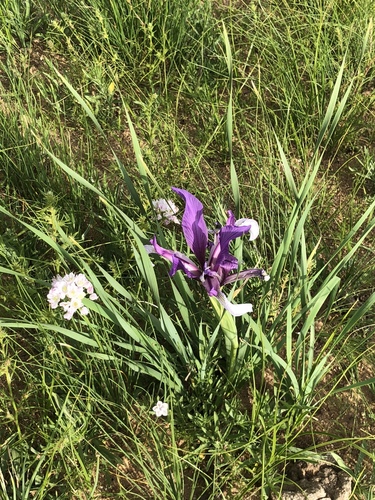
Iris bungei Maxim. is an iris species with a form intermediate between Iris tenuifolia and Iris ventricosa. It has knobbly, woody rhizomes that spread to create dense clumps of plants. It has red-brown or maroon-brown fibres or sheaths that are 10–13 cm long, which are the remains of the previous season's leaves. It has linear, green leaves that are 20–50 cm long and 0.2–0.4 cm wide, with 4–7 veins per leaf. It has a short flowering stem 12–15 cm long; in some years, the flowers are barely above the soil. It produces one or two terminal flowers at the top of the stem, flowering between April and May in Europe, and between May and June in Asia. It has 3 large green ovate spathes (flower bud leaves) 3–8 cm long and 1–3 cm wide, which explains its common names 'Big bud Iris' and 'Big Bract Iris'. Unlike Iris ventricosa, it has parallel veins on its spathes, instead of reticulate veins. The flowers are 5–7 cm in diameter, and come in shades of violet, purple, lavender and blue. It has two pairs of petals: 3 large outer petals (sepals) known as 'falls', and 3 smaller inner petals (or tepals) known as 'standards'. The falls are oblong and oblanceolate (wider at the top than the bottom), measuring 5–6 cm long and 1.2–1.5 cm wide. They have a small, thin yellow signal area and are marked with purple veins or marks. The standards are erect, narrowly oblanceolate, 5–5.5 cm long and 8–10 mm wide. It has a 1.5 cm long pedicel, a filiform (thread- or filament-shaped) perianth tube 6–7 cm long, 3 cm long stamens, and a 4–4.5 cm long ovary. It has 5–5.5 cm long style branches that are the same colour as the petals. After flowering, it produces a narrow, cylindric seed capsule 8–9 cm long and 1.5–2 cm wide in July and August. The capsule has 6 veins and a long beak-like appendage on the top. Iris bungei is native to temperate areas of eastern Asia. It is commonly found in Mongolia, within the Altai-Gobi and Altai Mountain Regions. It can also be found in eastern Siberia, Tibet, and China, in the provinces of Gansu, Nei Mongol, Ningxia and Shanxi. It grows in sandy grasslands, deserts and on dunes. It is rare in cultivation in the UK, Europe and USA, where it is only grown by collectors and for scientific research. It is hardy to USDA Zone 3, and needs mild and dry winters to survive. It is best planted between September and October. Specimen plants can be found growing in the Botanical Garden of the University of Halle. It is used in traditional Chinese medicine. The root of Iris bungei is a source of the organic compounds Irilin A, Irilin B (which is also found in red clover leaves), and Irilin D, all of which are used in supplements. Tetra-hydroxy-6-methoxyisoflavone, also known as Irilin D, can also be found in Iris japonica or belamcanda chinensis (Iris domestica). In December 2005, plants growing in the ranges of Mongolia were studied for palatability to various farm animals. Cattle and sheep do not eat Iris bungei, goats find the plant desirable, horses eat the plant as a last resort, and camels find the plant edible.