About Sisyrinchium demissum Greene
Species Identity and Growth Form
Sisyrinchium demissum Greene is a herbaceous cespitose (tufted) plant that grows up to 50 centimeters tall, with a clump-like form resembling grass.
Leaf Characteristics
It produces basal leaves that emerge directly from the plant's base; these leaves are very narrow, measuring 0.5–5 millimeters in width, and typically reach almost half the total height of the plant's flowering stems when the plant is in bloom.
Root Structure
Its roots are dense, and range from fine to somewhat thickened.
Flower Placement and Stem Structure
Flowers are borne singly at the tips of branched, flattened stems. Each flowering stem branches once or twice, with the first node located 8–34 centimeters up the stem.
Spathe Characteristics
The two bracts positioned beneath the flowers, called spathes, are relatively large, wider than the supporting branch, green, hairless, and taper to a pointed tip.
Tepal Description
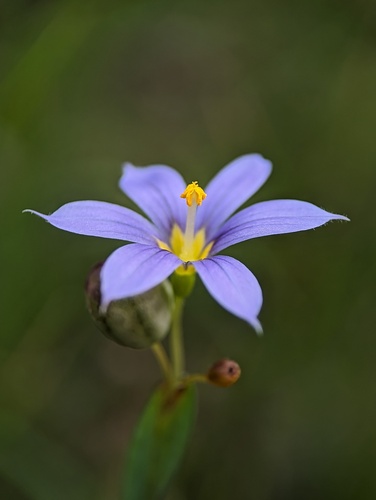
Each flower has six tepals, structures that resemble both petals and sepals. The tepals are dark blue-violet with bright yellow bases, and have three to five darker veins running along their length. The outer tepals measure 6–15 millimeters in length.
Stamen Characteristics
At the center of the flower is a column of three yellow stamens.
Blooming Season
The species has a long blooming season, spanning from mid-spring to early fall.
Fruit Characteristics
After blooming, it produces a round, tan to beige capsule fruit, 4–8 millimeters in diameter.
Seed Characteristics
Inside the capsule are multiple small round seeds, 0.8–2 millimeters in size, which have either a smooth surface or are covered in small rounded protuberances (granular texture).
Native Range Overview
Sisyrinchium demissum is native to the desert southwestern United States and northern Mexico.
US Distribution
In the United States, it is most common in Arizona, New Mexico, Nevada, and Utah. It also occurs in Colorado, and a small area of far western Texas' Trans-Pecos region. Most observations of the species in Colorado are from the southern part of the state, but it has also been recorded in Weld County in the Pawnee National Grassland.
Mexico Distribution
In Mexico, it has been reported from the states of Baja California Sur, Chihuahua, Coahuila, Nuevo León, and Sonora.
Habitat Type
Its natural habitat consists of moist areas in deserts and higher elevation forest openings. It grows near seasonal and permanently flowing streams, in moist meadows, ciénegas, near springs, and along forest seeps.
Elevation Range
The species occurs at elevations ranging from 500 to 2900 meters.
Cultivation Use
Common name stiff blue-eyed grass, S. demissum is cultivated in native plant gardens, particularly in moist locations such as near downspouts.
Propagation Methods
Gardeners propagate the plant by growing it from seed, or by dividing existing clumps.
Winter Hardiness
It is winter hardy in USDA zones 3–8.
Germination Inhibition
Seeds of this species show a high level of germination inhibition: one study found only 15% of seeds sprouted after four weeks at 21 °C (70 °F).
Cold Stratification Germination
By contrast, 57% of seeds sprouted in the second week when planted at the same temperature with light, after being first stored at 4.5 °C (40 °F) for three months before planting.
Dark Germination Result
No seeds sprouted when planted in dark conditions.