About Iris acutiloba C.A.Mey.
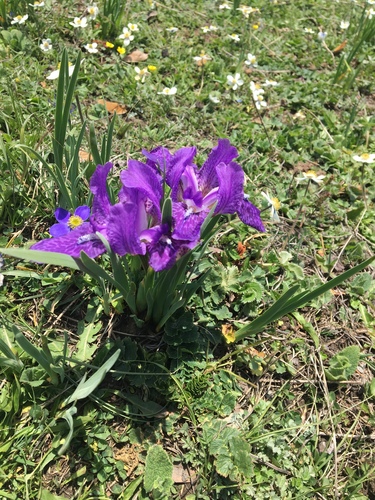
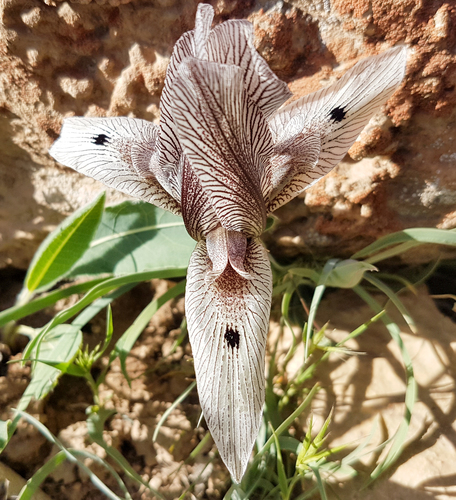
Iris acutiloba C.A.Mey. has small, thick, compressed rhizomes with multiple branches that give the plant a creeping growth habit across sun-warmed ground, forming clumps. Its leaves are narrow, slender, curved or falcate (sickle-shaped), glaucous, and coloured grey-green to medium green. They reach 10 cm long, and 0.2 to 0.6 cm wide. This is a dwarf iris species, with a slender stem or peduncle that grows 8 to 25 cm tall. The stem bears 5 to 8 cm long, lanceolate, membranous spathes (flower bud leaves), which are slightly pinkish or green. Each stem holds one terminal flower, which blooms in spring or early summer, between March (in Russia), April or May. Leaves begin growing in late autumn and stop growing in summer. In his book 'Iris', Fritz Kohlein wrote that the blossoms of this small plant produce a sombre, bat-like effect. The flowers are 5 to 8 cm in diameter, and come in shades from cream, creamy white, whitish, pale brown, light grey, to pale violet. They are streaked or heavily veined with brown, brown-black, grey, purple, or purple-brown. Like other irises, it has two pairs of petals: three large outer sepals called falls, and three smaller inner petals or tepals called standards. The falls are reflexed, pointed, or lanceolate, and grow up to 4 to 7 cm long. They are generally marked with two large spots or a deep purple signal patch, which can be dark red-brown, blackish, purple-violet, or dark purplish-brown; one spot sits in the centre and the other at the apex. In the middle of the falls is a sparse row of short hairs called the beard, which is coloured brown, purple, dark purple, or black. The acute, pointed standards are larger than the falls, grow up to 4 to 8 cm long, and are unspotted. Wild plants show more variation in colour and flower form. The plant has a greenish style branch 2 to 5 cm long with brown spots, a cylindric ovary, and green filaments and anthers. It also has a 1.5 to 2 cm long, cylindric perianth tube that is green dotted with purple. After flowering, it produces a seed capsule containing large, white and yellow seeds. It is endemic and native to temperate regions of Asia and the Caucasus, including Transcaucasia. It is found in Turkey, Armenia, Azerbaijan, Turkmenistan, Dagestan (near the capital Makhachkala and Barham), and Iran (also called Persia). It grows in mountains or dry hills, on rocky steppes, rocky slopes, or on sand. It can be found at altitudes between 1,500 to 3,000 m above sea level, or below 200 m when growing on sand dunes. Like many other irises, most parts of the plant (rhizome and leaves) are poisonous; mistaken ingestion can cause stomach pains and vomiting. Handling the plant may cause skin irritation or an allergic reaction. The species is hardy to European Zone H3, meaning it tolerates temperatures between −10 °C (14 °F) to −15 °C (5 °F). Because it grows in mountains, it is much more cold hardy than some Oncocyclus section irises native to Israel-Palestine. In Russia, it was tested for hardiness in various botanical gardens; it did not survive in Tbilisi, Baku, Frunze (also called Bishkek), Nalchik and Alma-Ata, and gave unstable results in the gardens of Moscow and St. Petersburg. Iris acutiloba and its subspecies 'lineolata' are dwarf, so they can be grown in pots with sharp drainage and careful watering, kept frost-free in a greenhouse, cold frame, or alpine house. They should be planted in sandy, well drained soils in full sun, and need protection from spring and autumn rains. When grown in pots, they are kept dry from September, and given fertilizer during the spring growing season; some plants have survived 3 to 5 years with this cultivation method. In 1904, it was rarely cultivated in the UK, and it is still fairly rare in cultivation in western regions. On 15 March 1900, a specimen was collected by Paul Sintenis near Baku, and later stored in the herbarium of the Komarov Botanical Institute. Due to an error, it was labeled as coming from Bailovo; the correct name of the region near the Danube is Brailovo.