About Indigofera caroliniana Mill.
Scientific Name and Growth Form
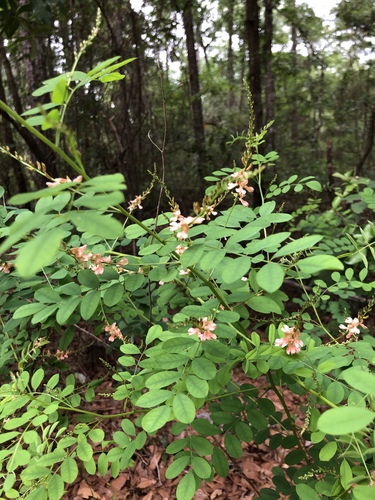
Indigofera caroliniana Mill. is a partially woody (suffruticose) herbaceous plant.
Height
It typically grows 0.5 to 1.2 meters tall, and can occasionally reach 2 meters in height.
Leaf Structure
Its leaves are 5 to 10 centimeters long, odd-pinnate, with a finely hairy rachis, and hold 9 to 15 obovate to oblanceolate leaflets.
Leaflet Dimensions
Each leaflet measures 1 to 2.5 centimeters long and 5 to 10 millimeters wide.
Leaflet Surface Features
Both leaflet surfaces are covered in fine minute strigillose hairs, with trichomes that attach at their midpoint, and leaflets are stipellate.
Inflorescence Characteristics
The inflorescences are slender axillary or terminal racemes, 6 to 20 centimeters long, and usually longer than the leaf they grow from.
Flower Arrangement
Flowers are loosely arranged, each borne on a roughly 1 millimeter pedicel with a small triangular bract.
Petal Features
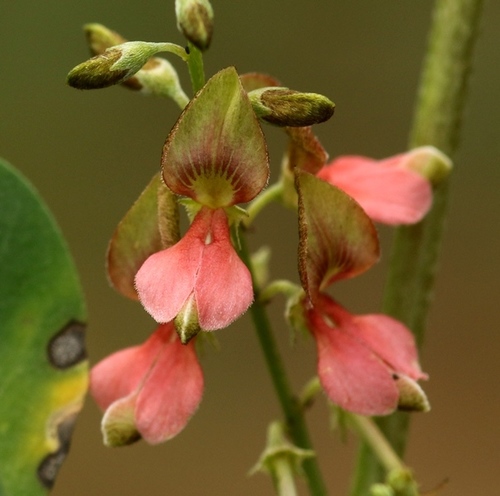
Petals range in color from pinkish to yellowish-brown; the standard and keel petals are 5 to 6 millimeters long, while the wing petals are slightly shorter and adhere to the pouched keel.
Stamen Structure
The stamens are diadelphous, arranged in a 9+1 pattern, with the connective extending above the anthers.
Fruit and Seed Characteristics
The fruit is a short-stipitate, beaked legume that is 5 to 10 millimeters long, and holds one to three seeds.
Root Tubers
The root system of Indigofera caroliniana produces stem tubers that store non-structural carbohydrates.
Tuber Function
These tubers let the plant resprout after fire and persist through periods without fire.
Geographic Distribution
Indigofera caroliniana is distributed from eastern North Carolina south to South Florida, and west to southeastern Louisiana.
Habitat
It grows in longleaf pine sandhills, maritime forests, Florida scrub, and other types of sandy forests and woodlands.