About Iberis amara L.
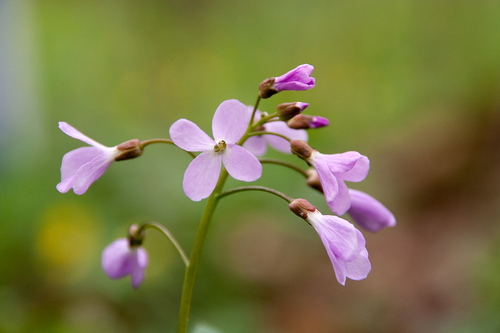
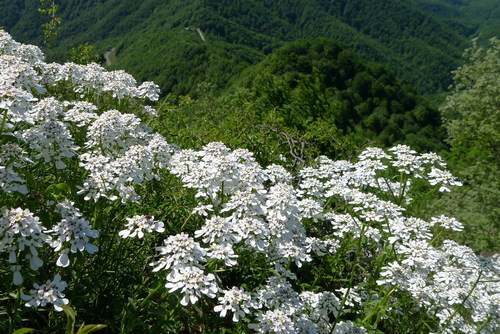
Iberis amara L. is a branched, erect annual plant that typically grows 10–30 cm (4–12 in) tall, and may sometimes reach 40 cm (16 in) in height. Its stems are roughly hairy in their lower sections and hairless above, with leaves scattered along the full length of the stems. Leaf blades are simple. Lower stem leaves are spathulate, growing to around 8 cm (3 in) long and 1.2 cm (0.5 in) wide. Upper stem leaves are either lanceolate or oblong‑cuneate, and can be as small as 3 cm (1.2 in) long and 0.4 cm (0.2 in) wide. All leaves are roughly sparsely toothed near their tips. The bractless inflorescence is a loosely arranged racemose corymb, holding 10 to 30 flowers, and elongates to 10 cm (4 in) when the plant develops fruit. Individual flowers are around 1 cm (0.4 in) across, growing on a thin thread‑like pedicel. This pedicel is either spreading or ascending, and measures about 1 cm (0.4 in) long. Each flower has four petals. In wild‑type Iberis amara, these petals are white or pale violet, while cultivated varieties come in deeper shades of pink, violet, or fuchsia. The petals are noticeably unequal in size: the two outer petals are nearly twice as long as the sepals. This uneven petal size is controlled by the timing of expression of the IaTCP1 gene, a member of the TCP protein domain family. This gene triggers extra cell proliferation in the two larger petals, which measure 5–8 mm (0.2–0.3 in) to 10 mm (0.4 in) long, and are obovate‑oblong with a cuneate base. The plant’s suborbicular siliculae (fruits) are typically 5 mm (0.2 in) in diameter, and may reach 7 mm (0.3 in). They have deeply notched tips, and wings that widen slightly toward the top. The plant’s styles are as long as, or slightly longer than, the apical notch, and the fruit valves have reticulate veins. The reddish‑brown seeds are around 3 mm (0.1 in) long, broadly ovate, and have a weak wing on their lower side. Iberis amara contains flavonoids including catechin, kaempferol, quercetin, and rutin, which can be extracted using the supercritical fluid extraction method.