About Hylobates lar (Linnaeus, 1771)
Fur Coloration
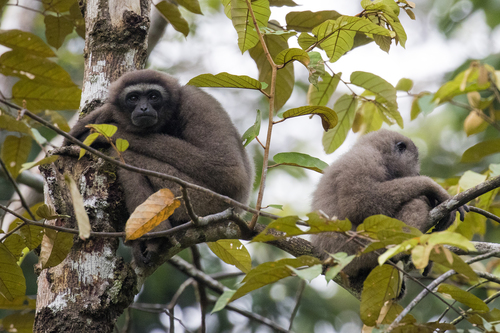
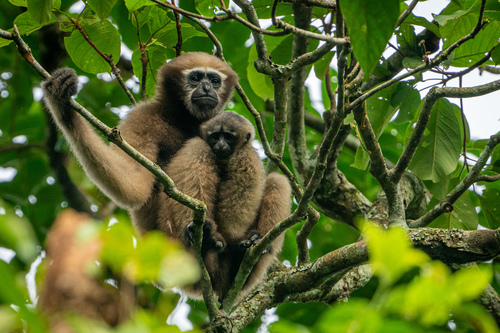
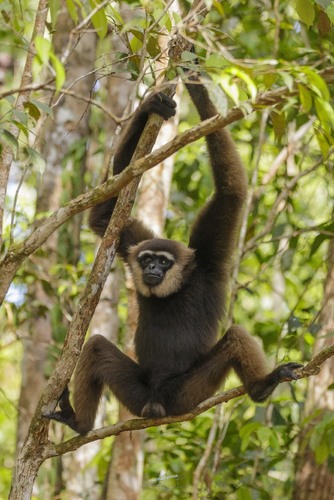
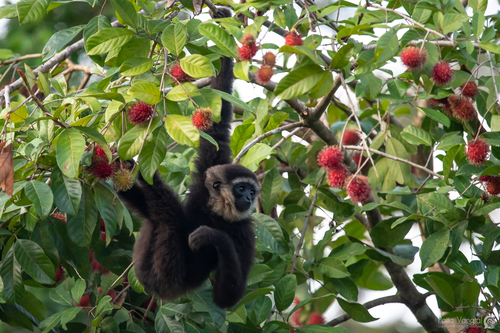
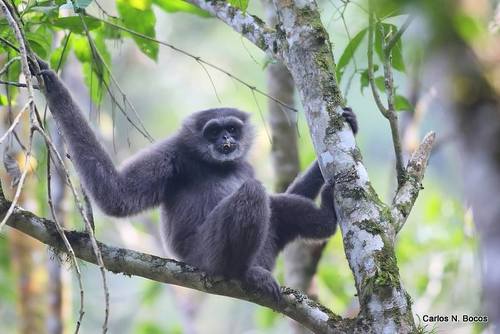
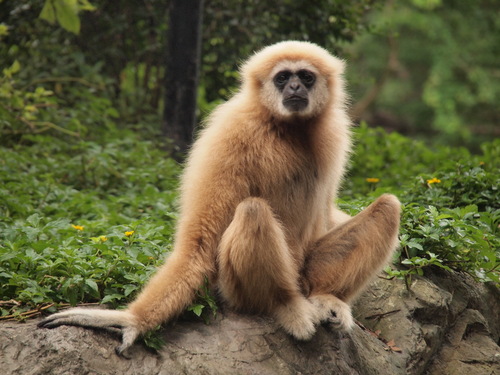
Physical description: The fur color of the lar gibbon, also called white-handed gibbon, ranges from black and dark brown to light brown and sandy shades. Its hands and feet are white, and a ring of white hair surrounds its black face. Both males and females can display any of these color variants, and there is almost no size difference between the sexes.
Locomotion Style
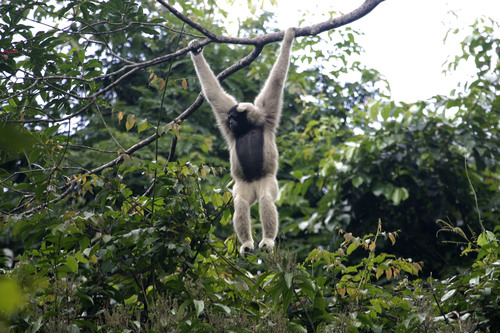
Gibbons are specialized brachiators, meaning they move through forest canopies by swinging beneath branches using their arms.
Brachiation Adaptations
In adaptation to this locomotor style, the white-handed gibbon has curved fingers, elongated hands, extremely long arms, and relatively short legs, which gives it an intermembral index of 129.7—one of the highest among primates.
Caudal Vertebrae Trait
Like all apes, lar gibbons have experienced extreme reduction in the number of caudal vertebrae, and as a result do not have a functional tail.
Ischial Callosities
They also have tough, bony sitting pads on their buttocks called ischial callosities.
Current Geographic Range
Distribution and habitat: Among all gibbon species, lar gibbons have the largest north-south geographic range. They are currently found in Indonesia, Laos, Malaysia, Myanmar, and Thailand.
Historical Geographic Range
Historically, their range stretched from southwest China to Thailand and Burma, and extended south across the entire Malay Peninsula, in both primary and secondary tropical rainforests. They also inhabit the northwestern part of the island of Sumatra.
Range Fragmentation
In recent decades, the portion of their range on continental Asia has shrunk and become fragmented.
China Population Status
Lar gibbons are considered likely extinct in China; if any small populations do remain, they would only be found in southwest Yunnan, the species' former range there.
Occupied Forest Types
Lar gibbons most often occupy lowland dipterocarp forest, hill dipterocarp forest, and upper dipterocarp forest, including primary lowland rainforest, submontane rainforest, mixed deciduous bamboo forest, and seasonal evergreen forest.
Elevation Range
They do not typically live at elevations higher than 1,200 meters (3,900 ft) above sea level.
Allopatric Range Separation
Gibbon species in the Hylobates genus are highly allopatric, with their ranges usually separated by large rivers. Because of this, lar gibbons range through southern and eastern Myanmar only east of the Salween River, across the entire Malay Peninsula, west of the Mekong River in northwestern Laos, and in northern Sumatra.
Sympatric Primate Species
Lar gibbons live in sympatry with multiple other primate and ape species, including orangutans (Pongo pygmaeus), siamangs (S. syndactylus), pileated gibbons (Hylobates pileatus), purple-faced langurs (Trachypithecus spp.), Thomas's langur (Presbytis thomasi), slow loris (Nycticebus coucang), and several macaque species (Macaca spp.).
Thailand Population Estimate
In Thailand, the lar gibbon population is estimated to be between 15,000 and 20,000 individuals.
China Population Estimate
If any lar gibbons still exist in China, the total population is likely as small as 10 individuals.
Mating Period
Reproduction: Sexually, lar gibbons share traits with other gibbon species. Mating can occur in any month of the year, but most conceptions take place during the dry season in March, leading to a peak in births during the late rainy season in October.
Female First Offspring Age
In the wild, female lar gibbons typically have their first offspring when they are around 11 years old, a much later age than is seen in captive individuals.
Gestation & Offspring
The average gestation period is six months, and pregnancies usually produce only one young.
Development & Maturity
Young lar gibbons nurse for approximately two years, and reach full maturity at around 8 years old.
Wild Life Expectancy
The average life expectancy of a lar gibbon in the wild is 25 years.