About Hydrochoerus hydrochaeris (Linnaeus, 1766)
Body Shape
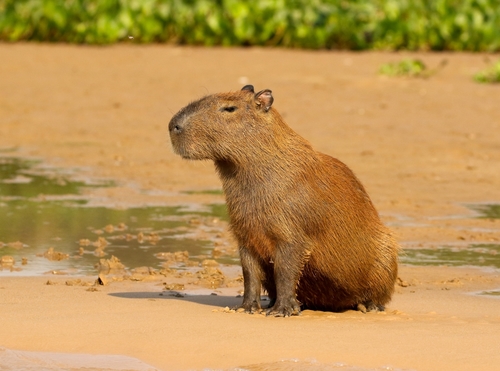
The capybara, Hydrochoerus hydrochaeris, has a heavy, barrel-shaped body and a short head.
Fur Coloration
Its upper body is covered in reddish-brown fur, which shifts to yellowish-brown on its underparts.
Sweat Glands
Unlike most rodents, it has sweat glands on the surface of its hairy skin.
Fur Structure
This species lacks down hair, and its guard hair is barely distinguishable from its over hair.
Adult Size
Adult capybaras measure 106 to 134 cm (3.48 to 4.40 ft) in length, stand 50 to 62 cm (20 to 24 in) tall at the withers, and typically weigh 35 to 66 kg (77 to 146 lb).
Average Weight
The average weight of capybaras in the Venezuelan llanos is 48.9 kg (108 lb), and females are slightly heavier than males.
Record Weights
The heaviest recorded wild capybaras are a 91 kg (201 lb) female from Brazil and a 73.5 kg (162 lb) male from Uruguay; an 81 kg individual was also reported in São Paulo between 2001 and 2002.
Dental Formula
This species has a dental formula of 1.0.1.3 / 1.0.1.3.
Limb Structure
Capybaras have slightly webbed feet, vestigial tails, and hind legs that are slightly longer than their forelegs.
Toe Count
They have three toes on their hind feet and four toes on their front feet.
Head Features
Their muzzles are blunt, and their nostrils, eyes, and ears are all positioned near the top of their heads.
Karyotype
The capybara karyotype has 2n = 66 and FN = 102, meaning it has 66 chromosomes with a total of 102 arms.
Native Range
Capybaras are semiaquatic mammals found across every South American country except Chile.
Habitat
They inhabit dense forested areas close to bodies of water including lakes, rivers, swamps, ponds, and marshes, as well as flooded savannah and tropical rainforest river corridors.
Swimming Ability
They are excellent swimmers that can hold their breath underwater for up to five minutes at a time, and they have thrived in cattle ranch habitats.
Home Range Size
In high-density populations, capybaras roam home ranges that average 10 hectares (25 acres).
Feral Populations
Escapees from captivity have established feral populations in similar watery habitats around the world.
North American Sightings
Sightings of escaped capybaras are fairly common in Florida, though no breeding population has been confirmed there; one individual was spotted on California's Central Coast in 2011.
Pleistocene Range Context
These escaped populations occur in regions where prehistoric capybaras once lived: late Pleistocene capybaras inhabited Florida, Hydrochoerus hesperotiganites inhabited California, and Hydrochoerus gaylordi inhabited Grenada, and feral North American capybaras may fill the ecological niche left by these Pleistocene species.
Estrus Detection
When a female capybara enters estrus, her scent changes subtly, prompting nearby males to begin pursuit.
Estrus Signaling
She also alerts males to her estrus by whistling through her nose.
Mate Choice
During mating, females hold the advantage and choose their mates.
Mating Location
Capybaras only mate in water, and if a female does not wish to mate with a particular male, she will either submerge herself or leave the water.
Dominant Male Guarding
Dominant males are highly protective of receptive females, but they usually cannot prevent subordinate males from mating.
Guarding Difficulty
The larger the capybara social group, the harder it is for a dominant male to guard all females.
Mating Frequency
Dominant males get significantly more matings than any single subordinate, but subordinate males as a group account for more total matings than dominant males.
Sperm Traits
Capybara sperm has a longer lifespan than the sperm of other rodents.
Gestation and Litter Size
Capybara gestation lasts 130 to 150 days, and females produce an average litter of four young, though a single litter can range from one to eight young.
Post-Birth Behavior
Birth takes place on land, and the female rejoins her main social group within a few hours of giving birth.
Newborn Development
Newborn capybaras join the group as soon as they are mobile.
Weaning Process
Within one week of birth, young capybaras can eat grass, but they continue to suckle from any female in the group until weaning at around 16 weeks old.
Juvenile Behavior
Young capybaras form their own smaller group within the main social group, and alloparenting has been observed in this species.
Breeding Peaks
Breeding peaks between April and May in Venezuela, and between October and November in Mato Grosso, Brazil.