About Hyacinthoides italica (L.) Rothm.
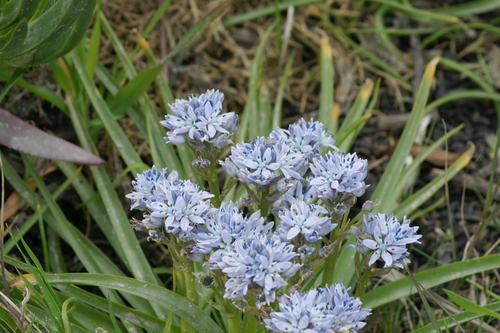
Hyacinthoides italica (L.) Rothm. reaches 10–40 centimetres (3.9–15.7 in) in height, with a completely leafless stem. It produces 3 to 6 basal, lance-shaped leaves that measure 7–15 centimetres (2.8–5.9 in) long and 4–15 millimetres (0.16–0.59 in) wide. Its inflorescence is a dense, conical or pyramid-shaped raceme that holds 5 to 30 bright violet-blue, star-like flowers. Each flower is accompanied by two narrow bracts. The flowering period for this species runs from February to May.
This species is intermediate in several characteristics between the common Hyacinthoides species H. non-scripta and H. hispanica. It has slender leaves matching or even exceeding the slenderness of H. non-scripta leaves, while it produces a dense flower raceme like H. hispanica, unlike the sparse, one-sided raceme of H. non-scripta.
Hyacinthoides italica is grown as an ornamental plant, and has been awarded the Royal Horticultural Society's Award of Garden Merit. It is native to the central Mediterranean region, where it occurs in northwestern Italy, southern France, and northeastern Spain. Its typical habitat includes olive groves, dry stony meadows, and forest clearings, growing at elevations up to 1,700 metres (5,600 ft) above sea level.