About Hippocamelus bisulcus (Molina, 1782)
Nomenclature
The south Andean deer, also known as huemul, has the scientific name Hippocamelus bisulcus (Molina, 1782).
Body Build Adaptation
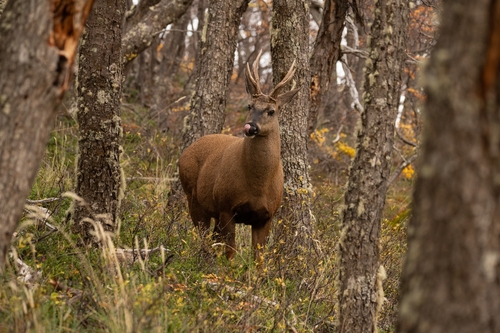
This species is well adapted to broken, difficult terrain, with a stocky build and short legs.
Coat Coloration
Its coat ranges from brown to greyish-brown, fading to white on the undersides, and has white markings on the throat.
Coat Function
The coat’s long, curled hairs protect the deer against cold and moisture.
Adult Size and Weight
Adult females (does) weigh 70 to 80 kg (154 to 176 lbs) and stand 80 cm (31 in) tall, while adult males (bucks) weigh 90 kg (198 lbs) and stand 90 cm (35 in) tall; other sources cite lower weight estimates for this species.
Fawn Characteristics
Fawns show no sexual size difference, and are born unspotted.
Antler Trait
This species has notable sexual dimorphism: only bucks grow antlers, which are shed annually toward the end of winter.
Male Facial Markings
Males also have a distinctive black "face mask" that curves into an elongated heart shape, surrounding a brown forehead.
Group Social Structure
Unusually for a sexually dimorphic ungulate, research shows south Andean deer congregate in mixed-sex groups, and the amount of time individuals spend intermixing increases as group size grows.
Group Size Drivers
Observed group size is larger the farther the animals are from rocky slopes, which suggests predation rates are lowest on slopes and highest in open areas like valley bottoms.
General Habitat Preferences
This deer occupies a range of often difficult habitats, and generally prefers open periglacial scrubland, low bluffs, other rocky areas, upland forests, and forest borders.
Sex-Specific Habitat Use
A study of coastal fjord populations found males and juveniles preferred periglacial grassland, females were mainly found on bluffs, and fawns were found exclusively on bluffs.
Diet Composition
One population study recorded Gunnera plants as a main dietary item, while a study in Argentina’s Nahuel Huapi National Park identified 32 different plant items in the species’ diet.
Primary Dietary Plant
In this study, the most common dietary plant was Lenga beech, which is also a primary food source for introduced red deer.
Dietary Overlap Impact
This dietary overlap displaces the smaller south Andean deer to marginal habitats, increasing its vulnerability.
Historical Distribution
Historically, the south Andean deer was found across much of southwestern South America.
Conservation Status
Its current conservation status is critical.
Argentina Population Estimate
As of 2005, Argentina’s population was estimated at 350 to 600 fragmented individuals.
Conservation Policy Criticism
Argentinian national authorities have been criticized for describing the species’ situation as satisfactory, while research documents continuing population declines.
Recommended Conservation Actions
Researchers have urged further study into habitat viability and the establishment of new conservation centers.
General Threats
Threats to huemul populations include economic activities and invasive species.
Argentina Population Threats
In Argentina, both reduced reproduction rates and increased morbidity are impacting the population; the cougar, the south Andean deer’s only natural predator, remains the leading cause of mortality for the species in Argentina.