About Heracleum mantegazzianum Sommier & Levier
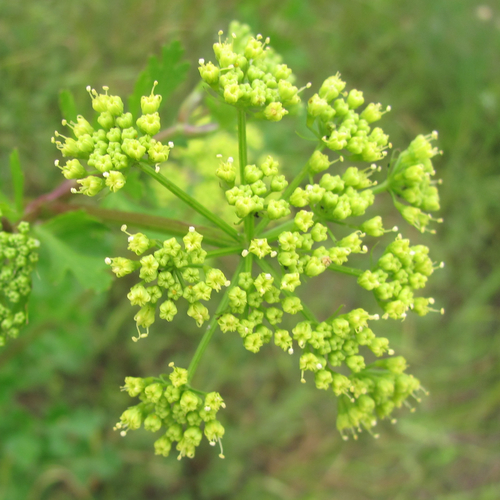
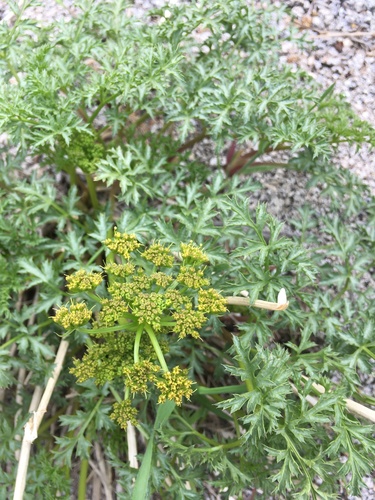
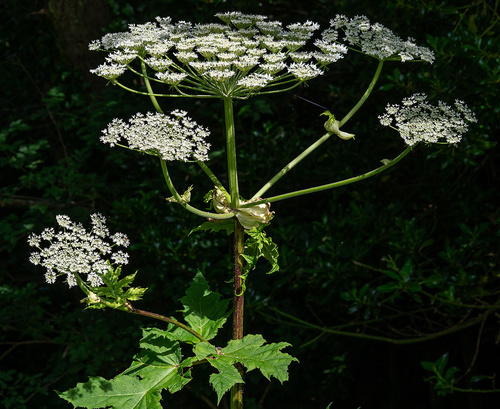
Giant hogweed, scientifically known as Heracleum mantegazzianum Sommier & Levier, typically grows 2 to 5 m (6+1⁄2 to 16+1⁄2 ft) tall. Under ideal growing conditions, one plant can reach a height of 5.5 m (18 ft). Its leaves are incised and deeply lobed. Mature giant hogweed produces very large leaves, between 1–1.5 m (3+1⁄2–5 ft) wide. In some cases leaves can grow up to 2.6 m (8.5 ft) wide and 3 m (9.8 ft) long. The plant has a stout, bright green stem marked with extensive dark reddish-purple splotches and prominent coarse white hairs, with the highest concentration of hairs at the base of the leaf stalk. Stems are hollow and ridged, 3–8 cm (1–3 in) in diameter, occasionally reaching 12.5 cm (5 in) in diameter, and can grow over 4 m (13 ft) high. Each dark red spot on the stem surrounds a single hair. The plant’s umbrella-shaped inflorescence is called a compound umbel, and its flat top can reach up to 100 cm (3+1⁄2 ft) in diameter. Giant hogweed flowers are white or greenish white, and may be radially symmetrical or strongly bilaterally symmetrical (zygomorphic). Its fruit is a schizocarp, which produces a pair of dry, flattened, oval seeds. The seeds are approximately 1 cm (1⁄2 in) long, with a broadly rounded base and broad marginal ridges. They are tan with brown lines, called oil tubes, that run three-quarters of the seed’s length.
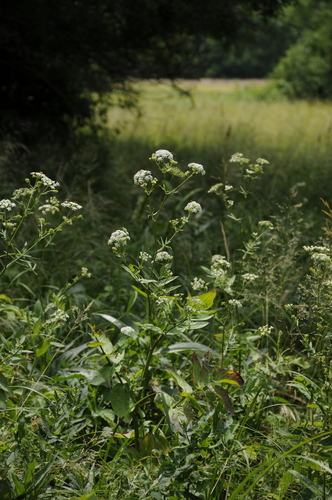
Giant hogweed is widespread across western and northern Europe, particularly growing in coastal areas and along riverbanks. It forms dense stands that can displace native plants and reduce wildlife habitat. It has spread into the northeastern and northwestern United States and southern Canada, and is classed as an invasive species across western Europe. Where it becomes established, it outcompetes the local native species Heracleum sphondylium. In Canada, the plant grows in most provinces, with the prairie provinces being the exception. It has been present in Quebec since the early 1990s. Its spread in Ontario started in the southwest, and it was first recorded in the Greater Toronto Area and Renfrew County near Ottawa in 2010. In the United States, giant hogweed occurs in Maine, Wisconsin, and extends south to Indiana, Michigan, Maryland, and New Jersey. In June 2018, the plant was reported growing in Virginia and North Carolina. It is federally listed as a noxious weed in the United States. The closely related species Heracleum sosnowskyi is widespread across Russia and the Baltic states, and is present in eastern Europe.
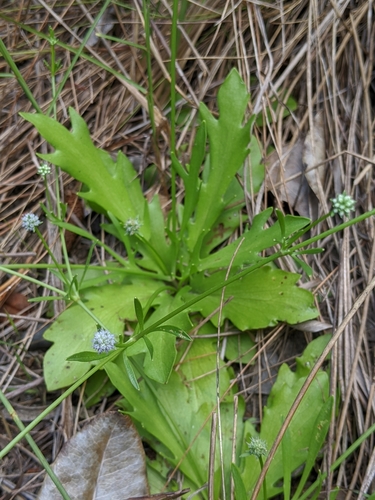
Giant hogweed is a herbaceous perennial with a four-phase life cycle, and is also a monocarpic perennial, meaning the entire plant dies after it flowers and produces seed. The first phase is the pre-flowering phase: in the first year, leaves sprout from the seed. In the following years, leaves grow from overwintering roots, forming a ground-level rosette with no above-ground stem. This pre-flowering phase can last for multiple years. Pre-flowering plants have leaves and stems that die back over winter each year, then regrow from the root in spring. Flowering typically occurs after 3–5 years of growth, though plants in unfavourable conditions can take up to eight years to flower; one plant in the Czech Republic was recorded flowering at 12 years old. In the northern hemisphere, flowering always takes place between June and July. The second phase is the flowering stage, which happens in midsummer: after several years of growth, the plant produces an erect flowering stem growing upward from its rootstock. The third phase is seed production, which occurs in late summer to early autumn, with seeds typically produced in August. On average, a single flowering giant hogweed produces 20,000 seeds, with total seed production ranging from 10,000 to 50,000 seeds per plant. The fourth and final phase occurs in late autumn to winter: after producing seeds, the entire plant dies, leaving dried dead stems and seed heads standing. Seeds slowly fall from the dead head and are dispersed by wind, water, animals, and people. Giant hogweed emerging seedlings are morphologically diverse; jagged pinnate and more rounded leaf shapes almost always both appear in the same seed bank.
Most seeds, around 95%, are found within the top 5 cm (2 in) of soil, within a few metres of the parent plant. Seeds can stay viable in the soil seed bank for over five years. Newly deposited seeds are initially dormant. Cold, wet autumn and winter conditions break this dormancy, so freshly deposited seeds stay dormant until at least the next spring. Around 90% of dormant seeds germinate when spring arrives, and the rest remain dormant in the seed bank. Seeds are normally produced by cross-pollination between two or more separate plants, but self-pollination can also occur. More than half of seeds produced via self-pollination will germinate to grow into healthy seedlings, which means a single isolated seed can establish an entire new colony of giant hogweed. Seeds are dispersed short distances by wind, but can be carried much longer distances by water, animals, and people.