About Astrantia carniolica Jacq.
Height
Astrantia carniolica Jacq. typically grows to an average height of less than 45 centimeters (18 inches).
Stem Characteristics
It has an erect, glabrous stem with few branches and few leaves.
Basal Leaf Features
Basal leaves have long 10–20 centimeter (3.9–7.9 inch) petioles, 3 to 7 lobes, and toothed segments, and measure 8–15 centimeters (3.1–5.9 inches) across.
Cauline Leaf Features
There are generally two cauline leaves, which are sessile, amplexicaul, lanceolate-shaped, and have a trilobed apex.
Inflorescence Size
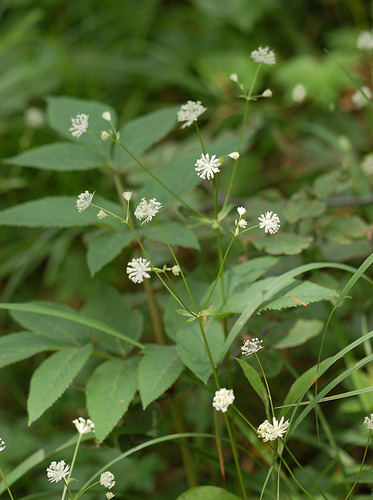
The inflorescence is umbrella-shaped, with a diameter of 2–3 centimeters (0.79–1.18 inches).
Floral Bract Characteristics
It has 10 to 20 numerous floral bracts, which are 10–18 millimeters (0.39–0.71 inches) long, reddish (sometimes white), and have an acuminate apex.
Flower Sexual Distribution
The small flowers are white: central flowers are hermaphrodite, while outer flowers are male.
Flower Reproductive Parts
Petals are white, and there are five stamens that are much longer than the petals.
Individual Flower Size
Individual flowers measure around 1–2 millimeters across.
Flowering Season
The flowering season runs from June to September.
Native Range
This species is native to the south-eastern Alps in Europe.
Country Distribution
It has been recorded in Austria, Bosnia and Herzegovina, Croatia, Italy, and Slovenia; in Slovenia, it occurs in the Julian Alps and near Lake Bohinj.
Habitat and Soil
It grows commonly in mountain grasslands, forests, clearings, and near streams, most often on calcareous (limey) soils, at an altitude between 1,500 and 1,600 meters (4,900–5,200 feet) above sea level.
Pollination
Astrantia carniolica is an entomophilous perennial, mainly pollinated by beetles, though it is also pollinated by other insects.
Vegetative Reproduction
It can also reproduce via buds located at ground level.
Recognized Cultivar
One cultivar, Astrantia carniolica 'rubra', is recognized by the RHS.
Cultivar Cultivation
This cultivar grows well in shaded, moist garden conditions, produces red summer flower color, and is hardy in USDA zones 5 to 9.