About Heptapleurum ellipticum (Blume) Seem.
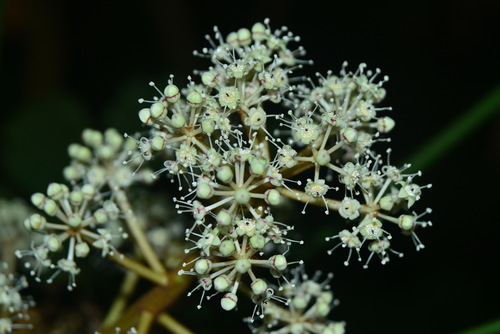
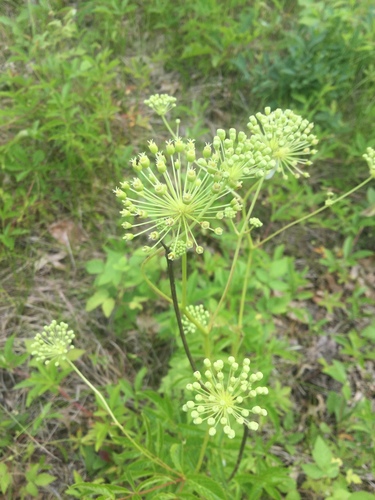
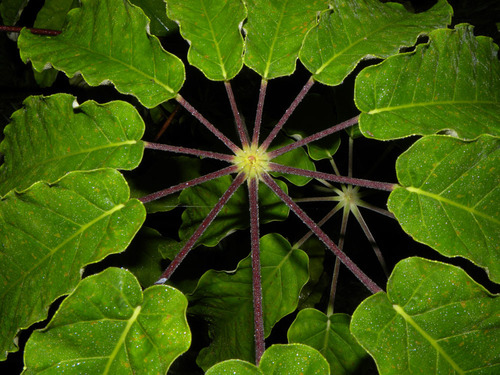
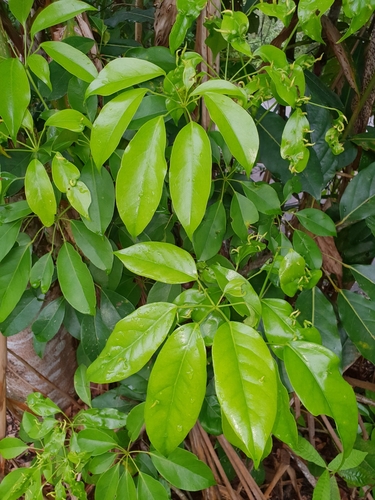
Heptapleurum ellipticum, commonly called the climbing umbrella tree, is a vine or scandent shrub that reaches up to 10 m (33 ft) in height, with a stem diameter of up to 9 cm (3.5 in). Its leaves are alternately arranged, with a petiole 4 to 14 cm (1.6 to 5.5 in) long. The leaves are palmately compound, bearing 4 to 7 leaflets. Each individual leaflet is around 6 to 18 cm (2.4 to 7.1 in) long and 2.5 to 10 cm (0.98 to 3.94 in) wide. Leaflets are leathery, glabrous, and typically have 5 to 6 pairs of secondary veins. The plant’s inflorescence grows to about 24 cm (9.4 in) long, with flowers arranged in umbels. Its fruit is globose and very small, measuring about 4–6 mm (0.16–0.24 in) in diameter. The natural range of the climbing umbrella tree extends from India through Southeast Asia and Southern China, to Melanesia, Papuasia, Christmas Island, and northern Australia. In Australia, the species is only found in the northeastern regions of Queensland. It grows mainly in rainforest and gallery forest, at elevations from near sea level up to 2,500 m (8,200 ft). This plant has been used in traditional medicine to treat multiple ailments, including coughs, edema, toothache, and wounds.