About Hepatica acutiloba DC.
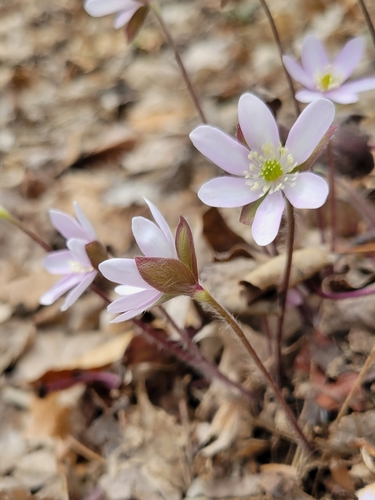
Hepatica acutiloba DC., commonly known as sharp-lobed hepatica, is a herbaceous flowering plant that belongs to the buttercup family Ranunculaceae. It is sometimes reclassified into the genus Anemone, with recognized synonyms including Anemone acutiloba, Anemone hepatica, and Anemone nobilis. This species grows in clumps, reaching a height of 5 to 19 cm (2.0 to 7.5 in) and blooms from early to mid spring. Its rounded flowers may be greenish-white, white, purple, or pinkish in color. After flowering, it produces fruits arranged in small, rounded columned heads that sit on pedicels 1 to 4 mm long. The mature fruits, called achenes, are ovoid in shape, measuring 3.5–4.7 mm long and 1.3–1.9 mm wide. They are slightly winged and typically lack a beak. Sharp-lobed hepatica is native to central eastern North America, where it grows in open deciduous woods, most commonly in calcareous soils. Historically, the Cherokee people used this plant to treat coughs; preparations were made as a tea or by chewing the plant's root.