About Hemiprocne longipennis (Rafinesque, 1802)
Adult Male Plumage
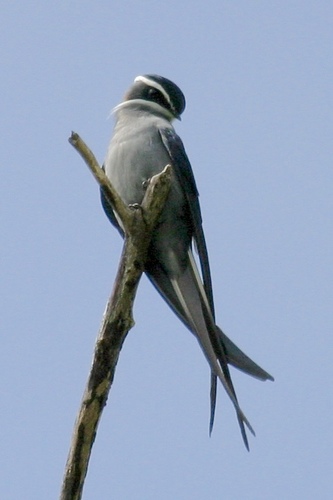
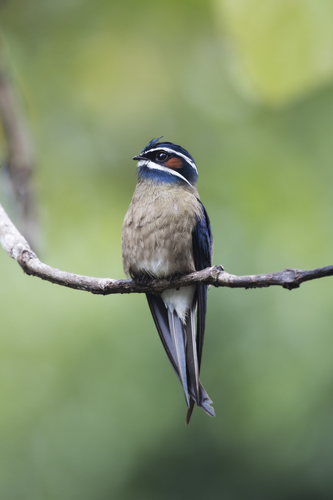
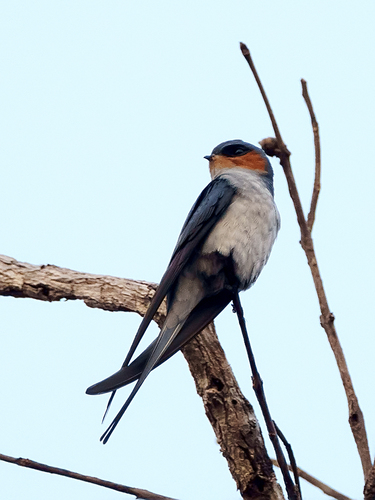
Adult males of Hemiprocne longipennis have a distinct dark grey throat and chest that contrasts with a white belly, and their ear coverts are dull orange-red or chestnut-colored.
Adult Female Plumage
Adult females do not have this dull orange-red or chestnut coloration on their ear coverts.
Perching Posture
When the bird perches, its wing tips cross over the tail.
Shared Plumage Trait
Individuals of both sexes have a greenish sheen on their upper body parts.
Species Distribution
This species is found in Brunei, Indonesia, Malaysia, Myanmar, the Philippines, Singapore, and Thailand.
Natural Habitats
Its natural habitats are subtropical or tropical moist lowland forests, subtropical or tropical mangrove forests, and subtropical or tropical moist montane forests.
Feeding Behavior
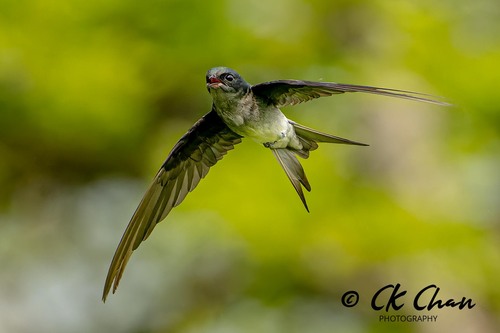
These birds occasionally catch insects in flight by sallying from perches.
Nest Placement
They build their nests on tree branches.
Nest Structure and Material
Their half-saucer-shaped nest is constructed from hardened saliva mixed with feathers, mosses, and/or flakes of tree bark.
Egg Attachment
Reportedly, the single egg produced is attached to the nest surface with saliva.
Nest Attachment Feature
Due to the fragile structure of the nest, it is only attached to the branch on one side.
Incubation Posture
Because of this, the bird does not sit directly on the nest to incubate the egg.
Brooding Behavior
Similarly, parent birds are reported to brood by perching on the branch above the nest and fluffing out their breast feathers to cover the nest.
Incubation Participation
Both sexes participate in incubating the egg.
Parental Care Shift Process
When shifting parental care between partners, the incoming partner perches near the currently incubating adult and carefully slides over the nest.