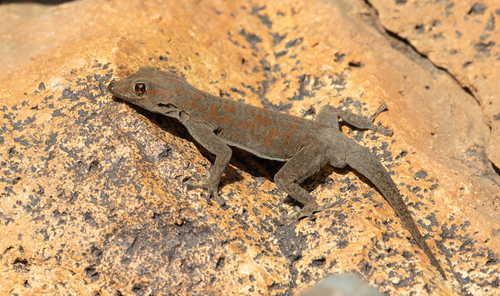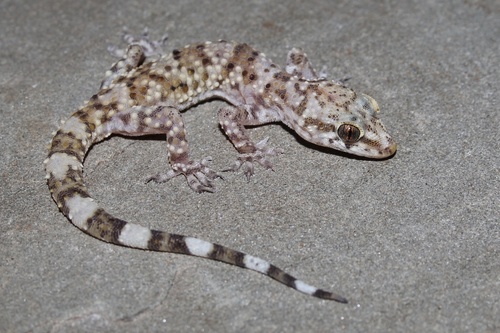
About Hemidactylus turcicus (Linnaeus, 1758)
Common Name and Size
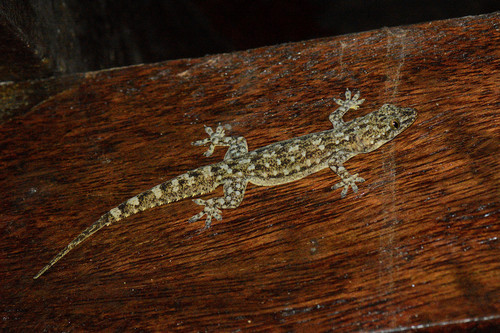
Hemidactylus turcicus, commonly called the Mediterranean gecko, is a very small lizard that generally reaches 10–13 cm (4–5 inches) in total length.
Head and Sensory Features
It has sticky toe pads, vertical pupils, and large eyes that lack eyelids.
Snout Characteristics
Its snout is rounded, and it is approximately as long as the distance between the eye and ear opening, measuring 1.25 to 1.3 times the diameter of the eye socket (orbit).
Forehead and Ear Features
The forehead is slightly concave, and the ear opening is oval, oblique, and nearly half the diameter of the eye.
Body and Limb Proportions
The body and limbs are moderately sized.
Digit Structure
Digit length varies across the foot, but the inner digit is always well developed.
Subdigital Lamellae Count
There are 6 to 8 lamellae under the inner digits, 8 to 10 under the fourth finger, and 9 to 11 under the fourth toe.
Head Scale Texture
The front of the head is covered in large granules, while the back of the head has minute granules mixed with round tubercles.
Rostral Scale Features
The rostral scale is four-sided, less than twice as broad as it is deep, with a medial cleft above it.
Nostril Placement
The nostril is located between the rostral scale, the first upper labial scale, and three nasal scales.
Labial Scale Count
This species has 7 to 10 upper labial scales and 6 to 8 lower labial scales.
Mental and Chin Shield Features
The mental scale is large and triangular, at least twice as long as the adjacent labial scales, with its pointed end positioned between two large chin-shields that may make contact behind it; a smaller chin shield sits on each side of this larger pair.
Dorsal Body Granules and Tubercles
The upper surface of the body is covered in minute granules mixed with large tubercles.
Dorsal Tubercle Arrangement
These tubercles are generally larger than the gaps between them, are suboval and trihedral in shape, and arranged in 14 or 16 fairly regular longitudinal rows.
Abdominal Scale Features
Abdominal scales are small, smooth, roundish-hexagonal, and overlapping (imbricate).
Male Preanal Pores
Males have a short angular series of 4 to 10 preanal pores, with 2 being an exceptional count.
Tail Shape and Scaling
The tail is cylindrical, slightly flattened, and tapering.
Tail Surface Scaling
Its upper surface is covered in minute scales and transverse rows of large, keeled tubercles, while its lower surface has a row of large, transversely expanded plates.
Coloration
The upper body is light brown or grayish with darker spots; many tubercles and all lower body surfaces are white.
Color Variation
Individuals may be completely translucent aside from their spotting, and some individuals have darker overall coloration.
Escape Behavior
When fleeing, Mediterranean geckos often move toward dark areas.
Social Structure
They can be found alone, or in groups of five or more individuals.
Native Range and Invasion Status
This species is native to the Mediterranean region, and is one of the most widely successful gecko species in the world.
Conservation Status
It has spread across much of the globe and established stable populations far outside its native range, and it is not classified as threatened or endangered.
Global Distribution
It occurs in countries with Mediterranean climates including Portugal, Spain, France, Italy, Greece, Israel, Malta, southern Bulgaria, North Macedonia, coastal Croatia (except western Istria), Bosnia and Herzegovina, the Adriatic islands, coastal Montenegro, coastal Albania, Cyprus, Turkey, northern Morocco, Algeria, Tunisia, Jordan, Syria, Libya, Egypt, Lebanon, northern Yemen (the Socotra Archipelago), Somalia, Eritrea, Kenya, southern Iran, Iraq, Oman, Qatar, Saudi Arabia, Pakistan, India, the Balearic Islands (Island Addaya Grande), the introduced Canary Islands populations of Gran Canaria and Tenerife, Panama, Puerto Rico, Belize, and Cuba.
1974 United States Distribution
As of 1974, it was recorded from scattered locations in the Southwestern United States (Arizona, California, Nevada, and New Mexico) and across a larger area of the Southern United States (Alabama, Arkansas, Florida, Georgia, Kansas, Kentucky, Louisiana, Maryland, Mississippi, Missouri, North Carolina, Oklahoma, South Carolina, Texas, and Virginia), with particularly well-established populations in eastern Gulf Coast states.
Recent Eastern US Records
More recently, published records document this species in several localities in Pennsylvania and Tennessee.
Indiana Occurrence Record
It was also reported from Indiana in 2019, though it was not known at that time whether the individual belonged to an established local population.
Introduced Mexican Distribution
In Mexico, introduced populations are known from the states of Tamaulipas, Veracruz, Tabasco, Campeche, Yucatán, Baja California, Chihuahua, Coahuila, Sonora, Durango, and Nuevo León.
Anthropogenic Habitat Use
Mediterranean house geckos occupy a wide range of habitats, most commonly in areas near human activity including university campuses, cemeteries, coastal regions, and shrublands.
Urban Microhabitat
In these urban or suburban areas, they are typically found in the cracks of old brick buildings.
Urban Habitat Adaptation Benefit
These urban habitats are less structurally complex than more natural settings, which supports the species' widespread success across its introduced range.
Natural Habitat Use
They can also occur in more natural areas including mountain cliffs and caves.
Nest Site Locations
Their nests are found in trash piles, attics, or under building baseboards.
Sexual Maturity Timeline
Mediterranean house geckos reach sexual maturity between four months and one year after hatching.
Mating Vocalizations
Males produce clicking sounds to attract mates, and females respond with their own squeaks.
Copulatory Behavior
This species practices copulatory biting, and stronger bites are associated with higher fertilization success.
Fertilization Method
Fertilization is internal.
Breeding Season and Clutch Traits
The breeding season typically runs from April to August each year, and eggs are laid between mid-May and August in an average clutch size of two.
Sperm Storage Adaptation
Females can experience delayed fertilization, as they can store sperm in a funnel-shaped organ called the infundibulum for up to five months.
Gestation Period
Because of this, the exact gestation length is unknown, but it is estimated to be around 40–60 days.
Parental Care Behavior
No parental care from either males or females has been observed; in fact, males have been recorded biting juvenile geckos.