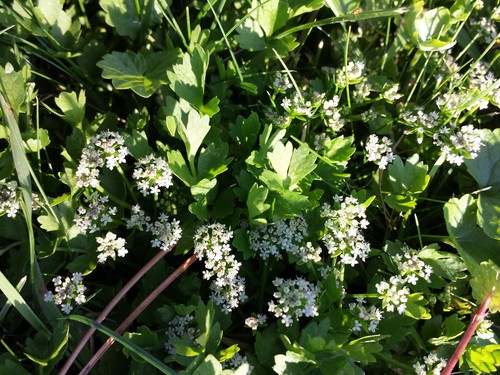
About Helosciadium repens (Jacq.) W.D.J.Koch
Helosciadium repens, commonly known as creeping marshwort, is a plant species belonging to the Apiaceae family. It occurs in Western and Central Europe, and is rare across its entire range. It grows in wetland areas where it does not need to compete with taller plants, due to animal grazing, periodic winter-spring flooding, or mowing. It is classified as near-threatened at the continental level, and is critically endangered and legally protected in Poland. It receives protection within the European Natura 2000 network. Creeping marshwort is a subatlantic species. Its core range extends across Western Europe, from the Iberian Peninsula north to the British Isles and Denmark, and east to Poland, Slovakia, Hungary, Croatia, and Montenegro. Isolated populations outside its core range are found in Turkey, Morocco, and the Canary Islands. As a naturalized species, it has been reported in the Czech Republic, North America, and the Swartland region in the Western Cape province of South Africa. Throughout its range, the species is rarely encountered. This rarity is shaped by both its specific ecological requirements and its poor ability to spread over long distances. In the southern part of its range, it grows in mountainous areas; for example, in Spain and Morocco, it grows at altitudes above 2300 meters above sea level. Creeping marshwort is a light-demanding pioneer species that grows on wet, nitrogen-rich soil. It occurs along water edges, especially lakeshores, in low vegetation communities flooded outside the growing season, and in gaps in reed beds. Another primary habitat is small terrain depressions that flood in spring and dry out later; in the Netherlands it also grows in seaside interdune depressions. In places flooded in winter and spring, bare soil becomes exposed after water levels drop, enabling the growth of light-demanding creeping marshwort. Animal grazing also favors its growth by removing competitive vegetation. Secondary habitats include extensive pastures, usually over 50 hectares, where cattle are grazed extensively, and sometimes horses, as well as trampled areas on water edges such as beaches and boat launching sites, and within recreational areas including landscaped lawns. However, excessive trampling and overgrazing can eliminate this species. It grows on fertile, moderately fertile, and poor nitrogen-rich soils, with pH ranging from neutral to slightly acidic or slightly alkaline. The mechanical and chemical composition of its soils varies between sites. Consistent traits of all its habitats are near-neutral soil pH and high humidity, although water levels often drop significantly by the end of summer. The species' habitats are either periodically flooded or inundated for longer periods, and it particularly prefers places flooded in winter. While it tolerates winter flooding well, prolonged submergence in summer can lead to plant death; plants die when flooded for more than 56 days, or when repeatedly inundated for shorter periods. It can tolerate shorter, less frequent floods, losing their roots and floating on the water surface. However, creeping marshwort growing in water does not flower. Summer submergence of its habitats stimulates seed germination. The species withers when exposed to saltwater, though it sometimes grows on slightly saline coastal alluvia. Because it is a pioneer species, occupied sites consistently have high frequency and intensity of disturbances that limit the development of competitive vegetation. Habitat conditions that support creeping marshwort development include low vegetation height (optimally not exceeding 20 cm) or at least the presence of gaps (for example in reed beds), no shading from trees and shrubs, and the absence of strongly growing expansive competitive species. The plants tolerate frosts down to -20°C. Due to the traditional, albeit incorrect, placement of this species in the Apium genus, this species and other Helosciadium genus members have likely been assigned similar nutritional and medicinal properties as the popular vegetable celery root. Clarifying the species' true relationships and systematic position does not change much in assessments of its edibility; lesser water-parsnip (Berula erecta), from the genus most closely related to Helosciadium, is also edible. The leaves of creeping marshwort have a pleasant, mild taste reminiscent of parsley. The long-standing recognition of creeping marshwort as a close relative of celeriac has led to initiatives to protect this species as a genetic reserve for celery.