About Helicolenus percoides (Richardson & Solander, 1842)
Head Characteristics
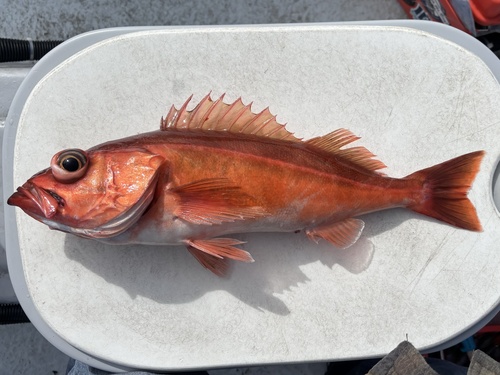
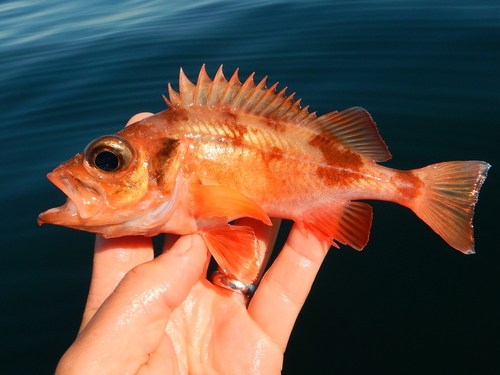
Helicolenus percoides has a moderately large, smooth head, whose length makes up 35 to 41% of the fish's standard length. It has moderately large eyes that do not bulge over the dorsal profile of the head. Each preopercle has 5 distinct spines along its front margin; the uppermost spine is quite small, and sits at the end of a low, spineless ridge underneath the eye.
Scales
Most of the head and the entire body are covered in small ctenoid scales.
Pelvic Fin Structure
The pelvic fins extend past the anus.
Dorsal and Anal Fin Structure
The dorsal fin has 12 spines and 11 to 12 soft rays, while the anal fin has 3 spines and 5 soft rays.
Maximum Size and Weight
This species reaches a maximum total length of 47 cm (19 in) and a maximum published weight of 1.4 kg (3.1 lb).
Base Body Coloration
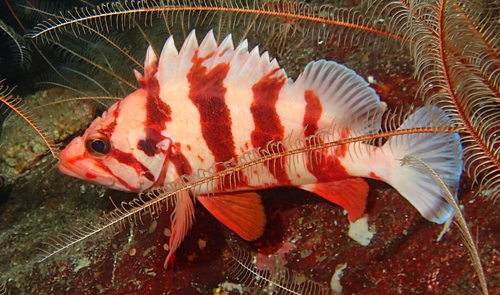
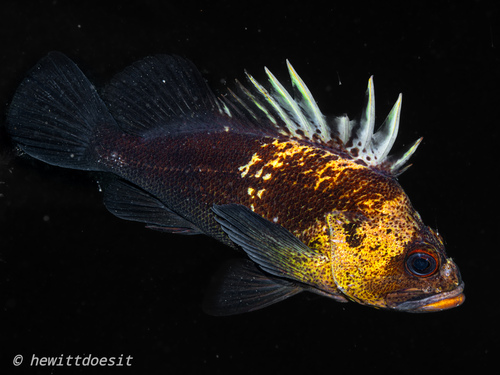
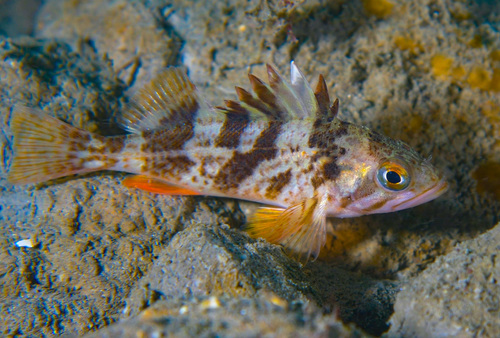
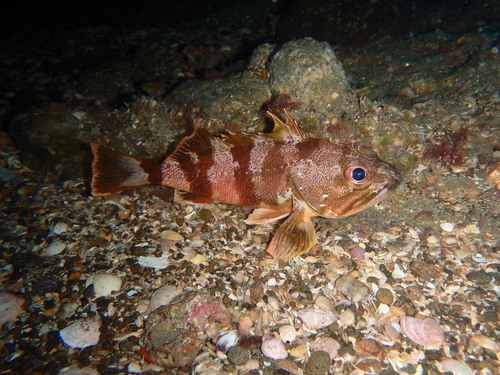
Its overall base color ranges from pinkish-orange to whitish, marked with three broad orange to dark brown bands on the flanks that continue onto the dorsal and anal fins.
Fin and Flank Markings
The two most anterior bands are usually split on the upper flanks, and there is often a single wide band on the caudal and pectoral fins.
Shallow Water Individual Coloration
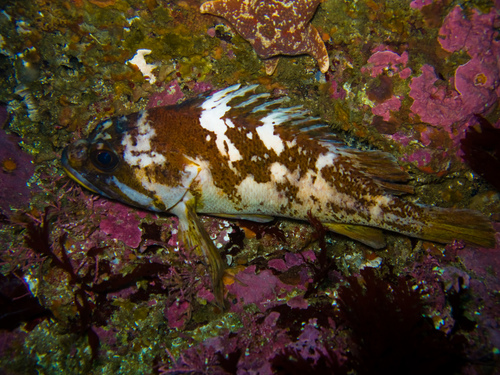
Individuals from shallow waters are typically darker, and frequently have dense dark speckling on the dorsal part of the head and flanks.
Species Distinction From H. barathri
Helicolenus percoides can be distinguished from the closely related H. barathri by differences in eye size and dorsal fin ray count. In H. barathri, eye diameter equals 34 to 41% of head length, and the dorsal fin normally has 13 to 14 soft rays. In H. percoides, eye diameter equals 27 to 33% of head length, and the dorsal fin normally has 11 to 12 soft rays.
Global Distribution
This species occurs in the southwestern Pacific Ocean.
Australian Range
In Australia, its range runs from northern New South Wales south to Tasmania, and west to Fremantle, Western Australia. It is also found around New Zealand.
Depth Habitat
It is a demersal fish that inhabits depths of 50 to 750 m (160 to 2,460 ft) on the continental shelf and continental slope.
Substrate Habitat
It can be found on coastal rocky reefs as well as open sandy areas, usually in deeper waters.
2003 NORFANZ Expedition Collection
During the month-long 2003 NORFANZ Expedition, which surveyed biodiversity of seamounts and slopes along the Norfolk Ridge, thirty specimens averaging 1 kg (2.2 lb) were collected from three locations.