About Hedera helix L.
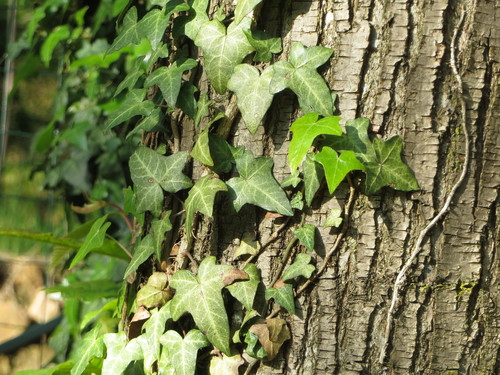
Hedera helix L. is an evergreen climbing plant that reaches 20–30 m (66–98 ft) high when growing on suitable vertical surfaces such as trees, cliffs, and walls; it grows as groundcover when no vertical surfaces are available. It climbs using aerial rootlets with matted pads that cling strongly to substrates. Its climbing ability on different surfaces varies by plant variety and other factors: H. helix prefers non-reflective, darker, rough surfaces with near-neutral pH. It generally grows well across a wide range of soil pH, with 6.5 being ideal. It prefers moist, shady locations and avoids direct sunlight, which causes drying out during winter. Its leaves are alternate, 50–100 mm (2–4 in) long, with a 15–20 mm (0.6–0.8 in) petiole, and occur in two distinct forms: palmately five-lobed juvenile leaves grow on creeping and climbing stems, while unlobed cordate adult leaves grow on fertile flowering stems exposed to full sun, usually high in tree crowns or at the top of rock faces. Flowers are produced from late summer to late autumn; they are individually small, borne in 3-to-5 cm-diameter (1.2-to-2.0 in) greenish-yellow umbels, and very nectar-rich, making them an important late autumn food source for bees and other insects. The fruits are purple-black to orange-yellow berries 6–8 mm (0.2–0.3 in) in diameter that ripen in late winter, and are an important food source for many birds. Each berry contains one to five seeds, which are dispersed after birds eat the berries. The native range of Hedera helix extends from Ireland northeast to southern Scandinavia, south to Portugal, and east to Ukraine, Iran, and northern Turkey. In Britain, it is very common and widespread, but is absent from the Isle of Man and Channel Islands. The species' northern and eastern range limits align approximately with the −2 °C (28 °F) winter isotherm, and it is replaced by other ivy species to the west and southwest. H. helix itself is much more winter-hardy, and can survive temperatures of −23.3 °C (−9.9 °F), corresponding to USDA Zone 6a, and warmer temperatures. Ivy berries are somewhat poisonous to humans, but ivy leaf extracts are used in modern cough medicines. A 2020 evidence review found that H. helix preparations may be a therapeutic option for treating early symptoms of respiratory tract infections. The strongest evidence for effectiveness of H. helix preparations is for treating cough: it works as an expectorant and reduces the frequency and intensity of cough, while only weak evidence supports effectiveness for all other researched symptoms. Historically, leaves and berries were taken orally as an expectorant to treat cough and bronchitis. In 1597, British herbalist John Gerard recommended water infused with ivy leaves as a wash for sore or watering eyes. The leaves can cause severe contact dermatitis in some people. People with this allergy, which is strictly a type IV hypersensitivity, are also likely to react to carrots and other members of the Apiaceae family, as these plants contain the same allergen, falcarinol. Studies have found that H. helix extract contains α-hederin, β-hederin, falcarinol, didehydrofalcarinol, rutin, caffeic acid, chlorogenic acid, emetine, nicotiflorin, hederasaponin B, and hederacoside C. However, only three extracted components are detectable in amounts greater than 1.5% in H. helix leaves: hederacoside C at 15.69%, chlorogenic acid at 2.07%, and rutin at 1.62%. Other components are detectable in very small amounts (less than 1%) or undetectable in some studies. Due to the large number of saponins in its leaves and fruits, H. helix is mildly poisonous to animals such as rabbits, and can cause anemia. Because of this moderate toxicity, birds limit how many ivy berries they ingest when foraging, but eat larger quantities of berries in spring, after the berries have ripened and lost some of their toxicity. H. helix extract is highly effective against fire blight, and has been observed to significantly inhibit the fire blight pathogen Erwinia amylovora for up to 7 days, with effectiveness similar to that of acibenzolar-S-methyl. Hedera helix is widely cultivated as an ornamental plant. Within its native range, it is highly valued for attracting wildlife: its flowers are visited by over 70 species of nectar-feeding insects, its berries are eaten by at least 16 species of birds, its dense evergreen foliage provides shelter, and it is browsed by deer. In Europe, it is frequently planted to cover walls. The Bavarian government recommends growing it on buildings because it cools building interiors in summer, provides insulation in winter, and protects buildings from soil moisture, temperature fluctuations, and direct exposure to severe weather. Additional uses include suppressing weeds in plantings, beautifying unsightly facades, and adding greenery by growing on tree trunks. However, ivy can be problematic. It is a fast-growing, self-clinging climber that can damage brickwork, guttering, and other structures, hide potentially serious structural faults, and shelter unwanted pests. Careful planning and placement are essential. As with any self-climbing facade greenery, intentional care is needed to get the most out of H. helix's benefits: ivy covering old walls is a familiar, often attractive sight that provides insulation and weather protection, dries soil and prevents damp walls, but can cause issues if not managed correctly. H. helix grows vigorously and clings via fibrous roots that develop along the entire length of its stems. These roots are difficult to remove, leaving unsightly marks on walls and potentially requiring expensive resurfacing work. Additionally, ivy can quickly invade gutters and roof spaces, lift roof tiles, cause blockages, and shelter mice and other unwanted animals. To prevent regrowth, the plants must be cut off at the base, and stumps must be dug out or killed. Hedera helix's insulating effect can reduce deterioration of limestone and other stone surfaces by protecting them from freezing events. A study in Southern England found H. helix reduces the frequency of freezing events by 26%, the duration of freezing events by 34%, and the severity of freezing events by 32%, alongside a noticeable reduction in damage to limestone material.