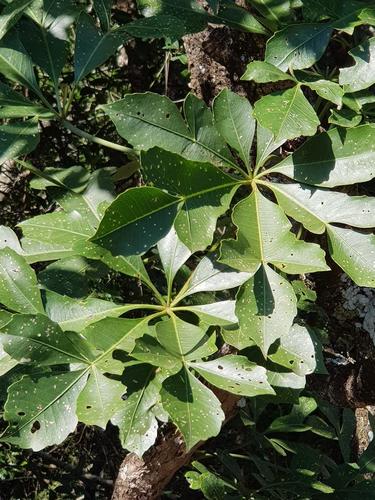
About Hedera crebrescens M.Bényei-Himmer & M.Höhn
On the creeping shoots of Hedera crebrescens, juvenile leaves are three-lobed. The upper, central lobe is dome-shaped and sharply pointed. Leaf bases often overlap, and leaf blades are broad, measuring nearly as wide as they are long. This ivy is slightly sensitive to frost, and suffers damage after long periods exposed to temperatures below −10 °C (14 °F). Only the terminal umbel produces fruit; all lateral umbels abort and wither. The berries within the terminal umbel are densely packed, green when immature and turning black once they ripen. Hedera crebrescens was first identified in Hungary, and has also been found in Austria, Germany, the Netherlands, Slovakia, and Ukraine. It prefers shaded, semi-humid conditions, and most commonly grows along railways, in and around cemeteries, parks, and unmaintained gardens. Observations recorded since the late 2010s show that H. crebrescens spreads easily, and is displacing other native ivy species from their habitats in parts of central Europe. Further studies are needed to assess the species' growth and distribution, and to put in place measures to control its spread. In 2022, the citizen science Ivy Mapping Project was launched in Hungary, which aims to map the current distribution of H. crebrescens using volunteer work.