About Panax quinquefolius L.
Scientific Classification Baseline
Panax quinquefolius L. is a herbaceous perennial plant.
Root Characteristics
It has an aromatic root that resembles a small parsnip, which forks as the plant matures.
Plant Height
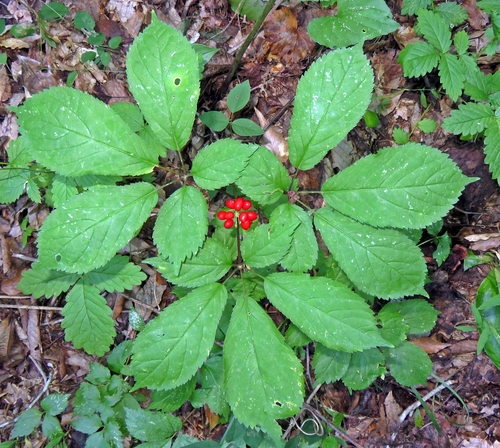
The species grows 6 to 18 inches (15 to 46 cm) tall, and usually bears three compound leaves sometimes called "prongs".
Leaflet Morphology
Each leaf holds three to five leaflets that are 2 to 5 inches (5 to 13 cm) long.
Similar Species
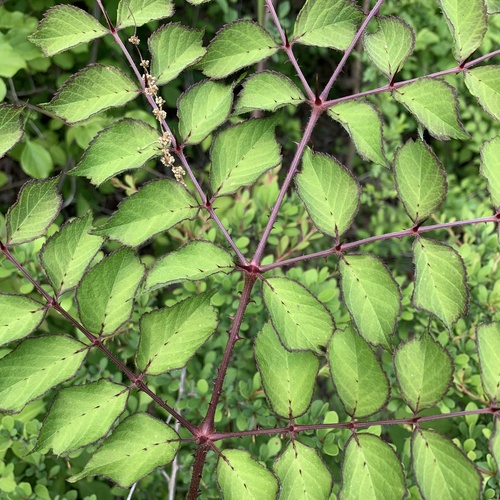
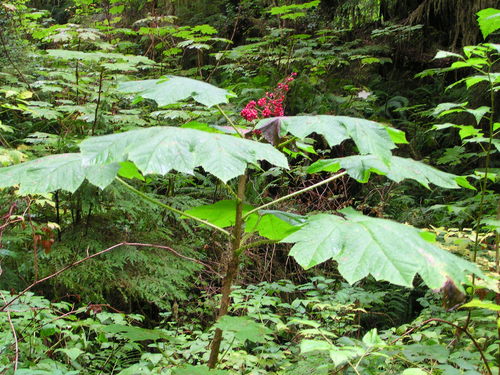
Panax quinquefolius is sometimes confused with wild sarsaparilla (Aralia nudicaulis), another member of the ivy family Araliaceae.
Leaf Structure Distinction
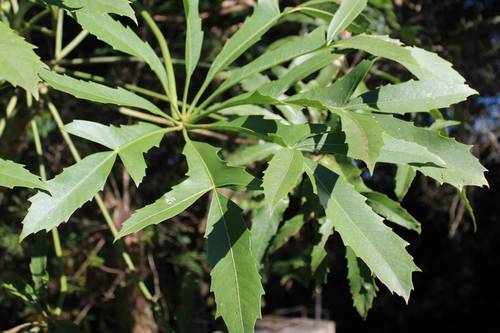
The two species can be distinguished by their leaf structure: Panax quinquefolius has palmately compound leaves, with leaflets radiating from a single point, while Aralia nudicaulis has pinnately compound leaves, with leaflets arranged on either side of a central stalk.
Native Range
Panax quinquefolius is native to the eastern United States and southeastern Canada.
Native Habitat
It is found primarily in the Appalachian and Ozark mountains of the United States, where it prefers full shade environments in deciduous hardwood forests.
Introduced Cultivation Range
It has been introduced and is cultivated in the Chinese provinces of Guizhou, Heilongjiang, Jiangsu, Jiangxi, Jilin, and Liaoning.
Flowering Period
Panax quinquefolius is a summer-flowering plant.
New England Phenology
In New England, flower buds and leaves emerge at the same time around mid-June, with flowers opening in July.
Fruit Maturation
Fruits mature to a deep red color by early September.
Seed Dormancy
Its seeds have a type of dormancy called morphophysiological dormancy, also sometimes called "double dormancy", which requires two full winters to break completely.
Germination Timeline
Germination occurs eighteen months after the fruit first ripens.
Contraindications for Anticoagulant Users
People requiring anticoagulant therapy such as warfarin should avoid using ginseng.
Other Use Contraindications
It is not recommended for people with impaired liver or renal function, or for use during pregnancy or breastfeeding.
Reported Adverse Effects
Other reported adverse effects include headaches, anxiety, trouble sleeping, and upset stomach.
Cultivation Contamination Risks
Cultivated American ginseng crops can be contaminated by fungal molds, pesticides, and various metals and residues, which creates health concerns.
Cultivation Industry Origins
As wild populations of American ginseng declined in the late 19th century, a market for cultivated ginseng developed.
First Commercial Cultivation
In 1887, tinsmith George Stanton planted ginseng in the forest around Apulia Station, a hamlet in the town of Fabius, Onondaga County, New York.
Industry Founder Designation
In his 1908 obituary, Stanton was called the Father of the Cultivated Ginseng Industry.
Commercial Shade Cultivation
Today, American ginseng is grown commercially under artificial shade, and crops grown this way are harvested three to five years after seeding.
Wild-Simulated Cultivation
It is also grown in forest-based, wild-simulated conditions, which require 6 to 10 years or more before harvest.
Cultivation Yield Comparison
By yield, forest farming of American ginseng is only one tenth as productive as commercial cultivation.
2024 Global Production Rankings
In 2024, American ginseng exports, an indicator of total cultivation and production, listed the four largest producers as Canada with 2,974,971 kg (6,558,688 lb), China with 2,165,977 kg (4,775,162 lb), the United States with 428,357 kg (944,366 lb), and South Korea with 333,355 kg (734,922 lb).
U.S. Conservation Cultivation Goals
Some U.S. states encourage planting ginseng both to restore natural habitats and reduce harvesting pressure on remaining wild populations.
U.S. Woods Cultivation Range
American ginseng is woods-cultivated in Colorado, Kentucky, Maine, North Carolina, Tennessee, Vermont, Virginia, and West Virginia.
Native American Medicinal Use Baseline
American ginseng held minor importance in Native American folk medicine.
Iroquois Traditional Use
The Iroquois ingested or smoked its roots as a panacea.
Menominee and Penobscot Traditional Uses
The Menominee of northern Wisconsin used it as a tonic and to improve mental capability, while the Penobscot of Maine used it to promote fertility.
Seminole Traditional Use
The Seminole of Florida used it to treat gunshot wounds.
Cherokee Historical Trade
In the late 19th century, the Cherokee sold large quantities of ginseng to traders for fifty cents a pound.
Cherokee Medicinal Preparation
According to ethnographer James Mooney, a decoction made from its roots was drunk to relieve headaches and cramps.
Cold and Flu Efficacy
There is currently no good evidence that American ginseng is effective for preventing or treating influenza or the common cold.