About Hedera canariensis Willd.
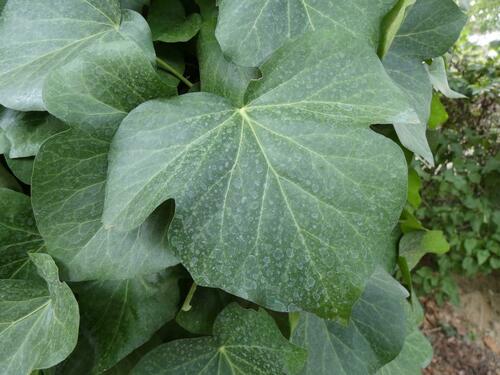
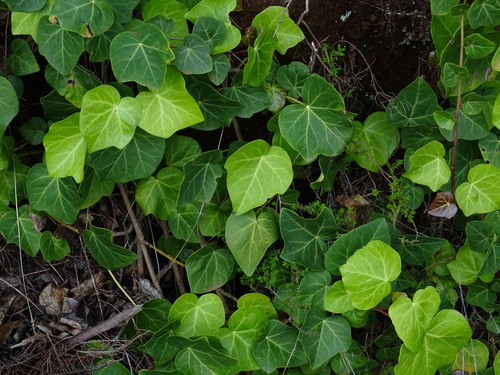
Hedera canariensis Willd. is an evergreen perennial woody plant that grows as a climbing, trailing shrub, bush, or ground cover. Where vertical surfaces such as trees, cliffs, or walls are available, it reaches 20–30 m in height; it forms ground cover when no vertical surfaces are present. It climbs using aerial rootlets that cling to its growing substrate. In warm climates, it grows and becomes established faster than the related species H. hibernica and H. helix. This plant is endemic to the Canary Islands, where it is quite common, especially in the Barbusano laurel forest. Its leaves are broad, measuring 5 to 20 cm across, glossy dark green, slightly leathery, with 1-5 lobes that are regular in size and shape. It is cultivated in gardens and used in floral arrangements. Its flowers are greenish, and its ripe fruits are globular and black. Young stems are green or greenish-brown, sometimes tinged with red or purple, and turn grey or grey-brown when the plant matures. As an evergreen climbing plant, it can grow from the bottom of ravines and river canyons to cover entire cliff or wall surfaces. It climbs with adventitious roots and can reach up to 50 meters in total length. This ivy is adapted to laurel forest, a type of cloud forest habitat. Like other ivies, it is a relict plant, one of the surviving members of the laurisilva (laurel forest) flora of Europe. This ancestral laurisilva flora originally covered most of the Mediterranean Basin during the Tertiary era, when the region’s climate was more humid. Around ten thousand years ago, at the end of the Pleistocene era, Mediterranean laurisilva forests disappeared as the Mediterranean Basin’s climate became harsher and drier. Today, laurisilva forest only persists in moderated-climate oceanic and island enclaves, including the North Atlantic Macaronesian islands. Ivies are opportunistic species that occur across wide distributions, with few close relatives; this pattern indicates recent divergence of the group. Hedera seeds are spread by birds. Hedera species from Macaronesian islands, northern Africa, and Europe are closely related. Until recently, researchers thought all these populations belonged to a single species, Hedera helix, but recent studies show they are several separate species that differ mainly in microscopic details of bud hairiness. Speciation in the genus Hedera is the product of vicariance, which formed after the geographical range of a more widespread common Tertiary ancestor became fragmented.