About Halichoeres maculipinna (Müller & Troschel, 1848)
Taxonomy and Size
Halichoeres maculipinna, a species of wrasse first described by Müller & Troschel in 1848, is generally less than 120 millimetres (4.7 in) long.
Body Shape
Its body is slightly elongated, with nearly symmetrical upper and lower portions.
Head and Dental Features
It has a pointed snout, rows of small teeth in both the upper and lower jaws, and two sets of canines in each jaw, located at the front and corners of the mouth.
Fin Structure
Its pectoral fin has 14 rays, its dorsal fin has 11 rays and 9 spines, and its anal fin has 11 rays and 3 spines.
Body Coloration
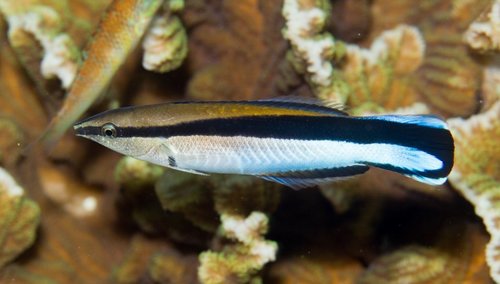
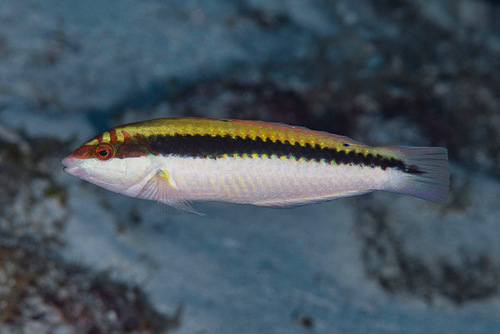
Its dorsal side is yellow, separated from its white ventral side by a black band.
Head Markings and Fin Spot
It has three red lines across the top of its head, and may have a dark spot on its dorsal fin.
General Distribution
This fish occurs in the northwestern Atlantic Ocean.
Detailed Range
Its range extends from North Carolina in the United States, south to Bermuda and Colombia, and is also found at Caribbean islands including Cuba and the Cayman Islands, and along the coast of the Central American country Belize.
Taxonomic Clarification for Brazil
It was once thought to also occur in Brazil, but a 2004 study led by Luiz A. Rocha showed that the Halichoeres populations native to Brazil belong to a different species, Halichoeres penrosei.
Primary Habitat and Depth
Halichoeres maculipinna inhabits the tops of coral reefs and rocky areas, and is most commonly found from 1 to 30 metres (3 to 100 ft) below the water surface.
Additional Habitat
It has also been recorded living in Sargassum beds off Venezuela.
Reproductive Biology
Like many other wrasses, Halichoeres maculipinna is a sequential hermaphrodite that can change sex from male to female.
Mating System
It uses a lek mating system, during which males are notably highly territorial.
Reproduction Method
It reproduces via spawning.