About Hakea sericea Schrad. & J.C.Wendl.
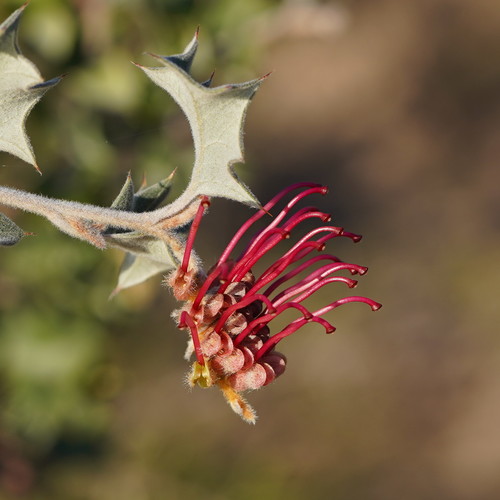
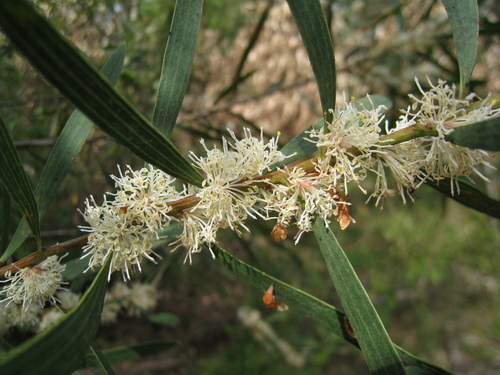
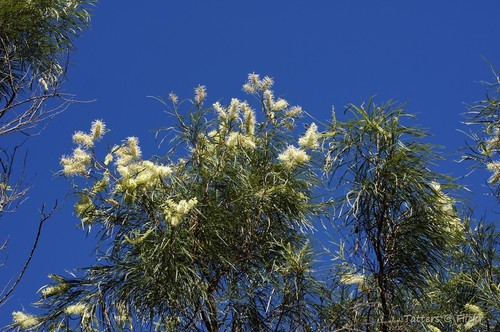
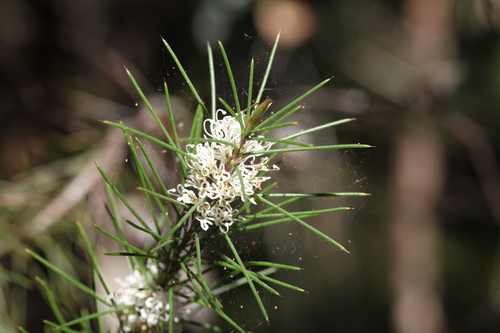
Hakea sericea Schrad. & J.C.Wendl. is a large, spreading, bushy shrub that can reach up to 4 metres (10 feet) in height, and does not form a lignotuber. Its branchlets are densely covered with short, soft, grey-whitish woolly hairs. Inflorescences grow as umbels holding 1 to 6 flowers in leaf axils; they are pinkish when in bud, and mature to white. The inflorescence rachis is 0.5–2.5 mm (0.020–0.098 in) long, thickly covered with short, matted woolly white hairs toward its tip, and rusty coloured at the base. Pedicels are 2–4 mm (0.079–0.157 in) long, with slight to dense coverage of long white hairs. The smooth perianth is 2.5–4.7 mm (0.098–0.185 in) long, and the pistil is 4–7.5 mm (0.16–0.30 in) long. The needle-shaped leaves are grooved on the undersurface, up to 7 cm (3 in) long and 0.7–1.3 mm (0.03–0.05 in) wide, ending in a sharp point 1–2 mm (0.039–0.079 in) long. Leaves are moderately covered with flattened silky hairs, which quickly wear away to leave the leaf surface smooth. The fruit of Hakea sericea is rough and coarsely wrinkled, with a network of veins across its surface. It is 2.5–3 cm (1–1 in) long, 2 cm (0.8 in) wide, and ends in a short, broad beak up to 3 mm (0.12 in) long. This species, commonly called silky hakea, is distributed from the coast and adjacent ranges of south-eastern Queensland to south-eastern New South Wales. It is a frost tolerant species that grows in well-drained soil and full sun. It is considered a good habitat plant due to its prickly growth habit and winter flowering. It is also naturalised in Victoria and possibly in South Australia. Outside of Australia, H. sericea is an invasive weed in some areas, specifically in South Africa, New Zealand and Portugal.