About Grevillea parallela Knight
Nomenclature
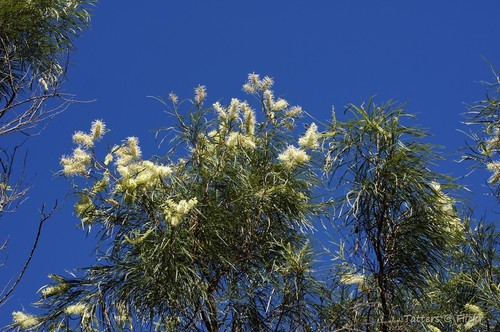
Grevillea parallela (scientific name Grevillea parallela Knight) is a single-stemmed shrub or tree that typically reaches 2.5–15 m (8 ft 2 in – 49 ft 3 in) in height.
Habit and Bark
It has dark, hard, furrowed bark and pendulous foliage.
Leaf Structure
Its leaves are pinnatisect or pinnatipartite, 100–400 mm (3.9–15.7 in) long, with 3 to 10 erect, linear to strap-like lobes.
Leaf Lobe Characteristics
These lobes measure 20–200 mm (0.79–7.87 in) long, 0.9–10 mm (0.035–0.394 in) wide, and are pale green-silvery grey.
Inflorescence
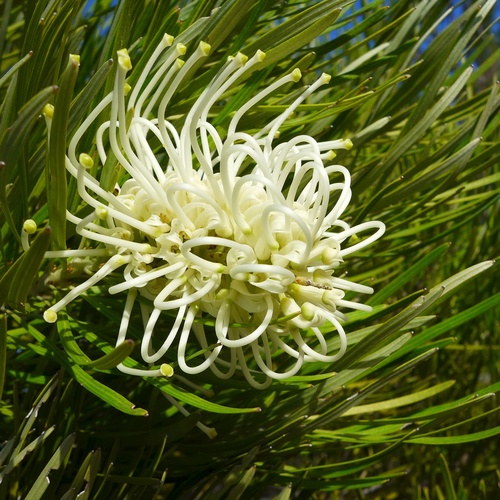
Flowers are usually arranged at the ends of branches in cylindrical clusters 60–100 mm (2.4–3.9 in) long.
Flower Characteristics
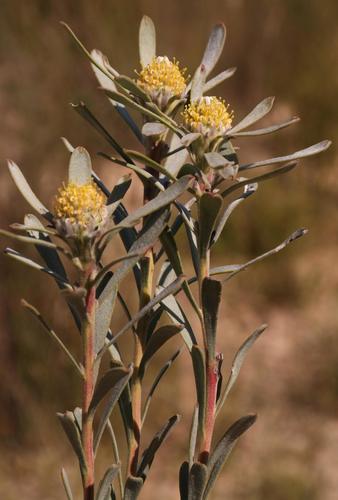
The blooms are white to cream-coloured or pale yellowish-green, with a pistil 13–26 mm (0.51–1.02 in) long.
Flowering Period and Fruit
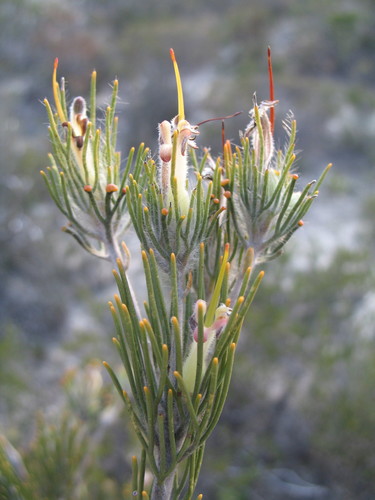
Flowering occurs mainly from June to October, and the fruit is an elliptic to lens-shaped follicle 14–29 mm (0.55–1.14 in) long.
Common Name and Distribution
Also commonly called silver oak, this species is found in northern Australia: the Kimberley region of Western Australia, the top end of the Northern Territory, and northern and central areas of Queensland.
Habitat Soil
It grows in a range of soil types derived from laterite, sandstone or granite.
Ecosystem Type
It is usually a component of open forest or woodland ecosystems with a grassy understorey.
Associated Species
Associated species include bloodwoods Corymbia polycarpa, C. tessellaris and C. nesophila, other eucalypts including Eucalyptus tetrodonta, E. miniata and E. platyphylla, plus Melaleuca viridiflora and Planchonia careya.