About Hakea salicifolia (Vent.) B.L.Burtt
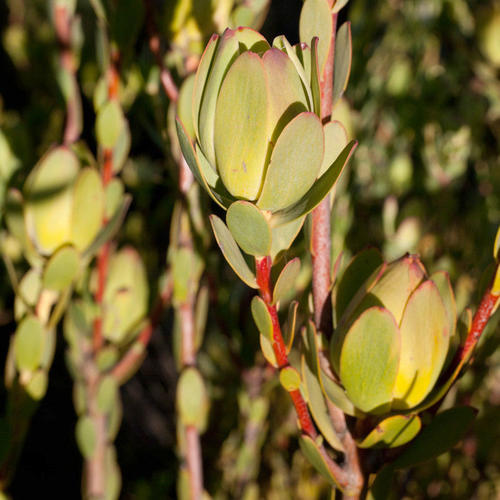
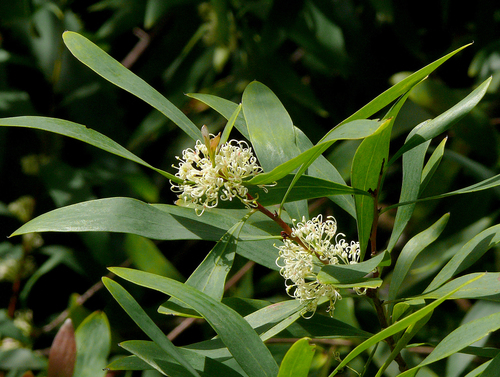
Hakea salicifolia is a fast-growing upright shrub or small tree that reaches 3–5 m (10–20 ft) in height. Its smaller branches are smooth, with distinct dark red longitudinal ribbing. Young shoots may be completely hairless, or have sparse silky hairs. Leaves are narrowly oval-shaped, widest at their midpoint, reaching up to 12 cm long and 5–20 mm (0.2–0.8 in) wide, and taper to a sharp point, or occasionally end in a rounded apex. The smooth leaves are pale green; they may also be bluish-green with a powdery coating. Young leaves are darker, with sparse flattened silky white and rust-colored hairs, and become smooth quickly as they mature. The inflorescence forms a single umbel holding 16–28 white to pale yellow flowers, borne on a short stalk 1–1.5 mm (0.04–0.06 in) long. Young flower bracts are 3 mm (0.1 in) long, and slightly hairy on their outer surface. Flower pedicels measure 4.5–7 mm (0.2–0.3 in) long. The smooth perianth is bluish-green with a powdery film, and is 2.3–3.5 mm (0.09–0.1 in) long. The style measures 6–6.5 mm (0.2–0.3 in) long. The egg-shaped fruit of Hakea salicifolia is 2.3–3.5 cm (0.9–1 in) long and 1.3–3 cm (0.5–1 in) wide. It narrows gradually to a slightly upturned beak that has small horns, and its surface is covered in black blister-like warts 1–5 mm (0.04–0.2 in) high. This is a widespread species native to eastern Australia, where it grows mainly between Kempsey and the Shoalhaven River, and also occurs at Dorrigo, Whian Whian, the Blue Mountains, and near the Queensland and New South Wales border. It grows in wet sclerophyll forest, often in areas adjacent to rainforest. Commonly called willow-leaved hakea, this species is an invasive environmental weed listed by the New Zealand Department of Conservation among approximately 300 environmental weeds in New Zealand, and it is also invasive in Portugal. It is grown as an attractive ornamental tree, and is adaptable to most soils and growing positions from subtropical to temperate zones; this adaptability has led to the species becoming overabundant and problematic in some non-native localities. It has been planted as a windbreak and boundary hedge on tea plantations in Tanzania.