About Hakea cucullata R.Br.
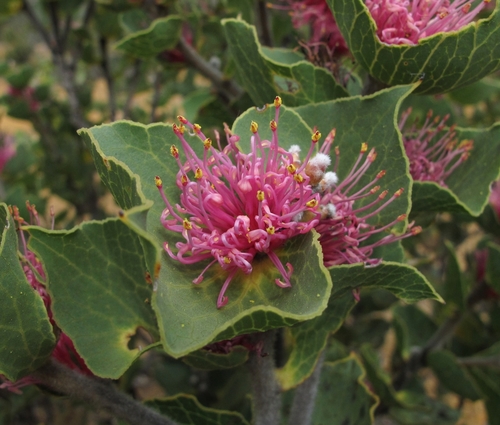
Hakea cucullata R.Br. is an erect shrub that grows to between 1 and 5 metres (3 to 20 ft) tall, and has few branches. Young branches are densely covered in short hairs, while flowering stems have dark brown hairs. Its leathery leaves are broadly egg-shaped, measuring 37 to 75 millimetres (1 to 3 in) long and 38 to 90 millimetres (1 to 4 in) wide. The leaves are pale green, and most often have wavy or finely toothed margins, with a prominent mid-vein that ends in a sharp point at the leaf apex. Leaves overlap more or less, and are distinctly cupped around the stem, flowers, and fruit. The inflorescence holds 25 to 30 deep pink flowers, which grow in leaf axils or at leafless nodes on bright pink stalks that are 5.5 to 8 millimetres (0.2 to 0.3 in) long. The perianth is deep pink at its base, and paler toward the tip. The smooth pedicels are 5.5 to 8 mm (0.22 to 0.31 in) long. The smooth, straight style measures 17 to 25 mm (0.67 to 0.98 in) long. Flowering occurs mainly from August to October. The woody, egg-shaped fruit is 2.2 to 2.8 cm (0.87 to 1.1 in) long and 1.4 to 2.0 cm (0.55 to 0.79 in) wide, and grows in groups of 1 to 5 in leaf axils. This species, also called hood-leaved hakea, is found in south-western Western Australia, ranging from the Stirling Range east to the Whoogarup Range, within the Esperance Plains, Jarrah Forest, and Warren biogeographic regions. It grows in sandy mallee heath, and occasionally in gravelly lateritic soils. In horticulture, the species (also called scallop hakea) is a reasonably hardy garden plant, and has been grown successfully on Kangaroo Island. It can be easily propagated from seed, and has also been successfully grafted onto rootstock of Hakea salicifolia.